


 Be The Investor Research
Investor Guides: A Practical Learning Path From First Investment to Portfolio Review

Choose an investor learning path covering first investments, company research, statements, valuation, ETFs, portfolio risk and thesis monitoring.
Good investment research connects several decisions: what the money is for, what a security owns, what the business earns, what the price assumes and how much risk reaches the portfolio. This learning path organizes Be The Investor's guides around those decisions.
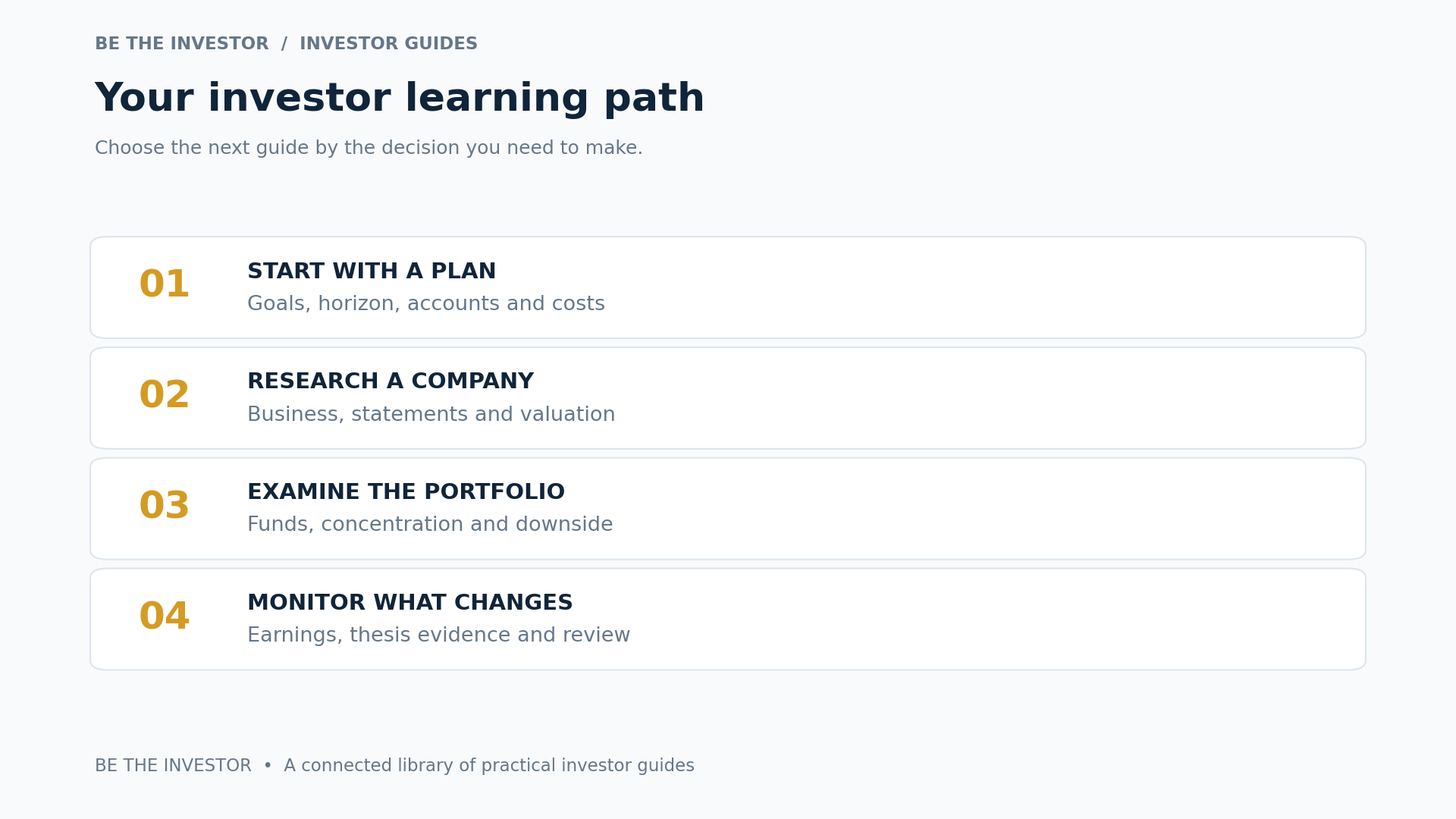
Start with the question you cannot yet answer. Each stage points to a practical guide and an output you can produce: an investment plan, a comparison table, a valuation range or a thesis review. The sequence is an educational framework, not a recommended portfolio.
Path 1: Start investing with a plan
If you are deciding how to begin, read How to Start Investing. Write down your objective, withdrawal horizon, available investment cash, costs and review rule before choosing a security.
Next, use How to Choose and Compare ETFs to examine a fund's mandate, holdings and implementation costs. The aim is to explain the exposure you would acquire, not simply select the fund with the most attractive recent return.
Finish this path with: a one-page plan and a product comparison tied to that plan. The SEC's allocation guidance is a useful primary reference for connecting investment choices with time horizon and risk tolerance.
Path 2: Research an individual company
Use the stock-analysis guide as the workflow. Identify how the business makes money, which operating drivers matter and what evidence could change your interpretation.
- Read the financial statements to connect revenue, profit, cash flow and the balance sheet.
- Work through stock valuation to select a method, identify assumptions and build a range rather than an unexplained target.
- Understand analyst ratings and price targets before treating an external opinion as your own investment case.
Finish this path with: a source-backed business summary, a financial-quality assessment and a valuation whose assumptions you can defend. For the wider research workflow across asset types, use the Complete Investment Research Guide.
Path 3: Build and examine a portfolio
Move from evaluating a security to asking what it does to the whole account. The guide to diversification, position sizing and portfolio risk connects weights, overlapping exposures and loss scenarios.
Choose the relevant product lesson:
- Dividend stocks and dividend safety: examine the business support behind a distribution.
- Bond investing: distinguish price, yield, duration and credit risk.
- Leveraged and inverse ETFs: study daily reset and compounding before analyzing a holding-period outcome.
Finish this path with: an exposure map and a scenario calculation. Product complexity should be a reason to study its mechanics, not an assumption that it offers a better return.
Path 4: Monitor what changes
Read How to Read Earnings Reports and Guidance to organize a results release into comparable figures, management outlook and unresolved questions. Then use How to Build and Track an Investment Thesis to connect that evidence to the original case.
Finish this path with: a dated update stating what is unchanged, what improved, what weakened and what remains unknown. Keeping the previous record makes it possible to distinguish a revised judgment from a rewritten history.
Practice with an issuer document
Open Vanguard's official VTI fund page and its fund fact sheet. Confirm the ticker and document date, locate the investment objective, and find the current prospectus. Record one question that the summary page does not answer.
This is a source-navigation exercise using a real security, not a recommendation to buy VTI. Do not copy a fee, holding or performance figure without its date and definition. The SEC's ETF bulletin explains why issuer documents and trading mechanics belong in the research process.
A hypothetical exercise: connect research to portfolio risk
Assume a fictional portfolio worth $20,000 holds $6,000 in one company. Its position weight is 30%. Now assume that company falls 40% while every other holding is unchanged.
The position loses $2,400: $6,000 × 40%. The portfolio falls to $17,600, a 12% decline. Equivalently, 30% position weight × 40% position loss = 12% portfolio loss.
These are illustrative assumptions, not a forecast, recommended weight or maximum-loss estimate. Costs, taxes and changes in other holdings are excluded. The company guide helps you assess the business; the valuation guide examines expectations; the portfolio guide shows how the chosen weight transmits an adverse outcome. Completing only one of those tasks leaves a different question unanswered.
Turn reading into a reusable investment record
- Record the decision you are trying to make.
- Link the original document supporting each material fact.
- Label assumptions and calculations separately from reported figures.
- Write down the strongest evidence against your view.
- Identify the next observation that could change the decision.
A useful record should still explain your reasoning when the result is disappointing. It should also reveal which inputs were missing at the time.
Frequently asked questions
Do I need to read every guide in order?
No. Begin with the path that matches your next decision. An ETF investor may start with fund selection and portfolio risk; an individual-stock investor will need business analysis, statements and valuation.
Do these guides tell me which security to buy?
They teach a research process and show calculations. A named security may serve as a source-navigation or analysis example. That does not establish its suitability for your circumstances.
How should I use a numerical example?
Identify the assumed inputs, reproduce the arithmetic and change an input to see what happens. Do not treat an illustrative return, valuation range or stress loss as a prediction. Use current primary documents when replacing the example with a real investment.
Educational material. Account rules and tax treatment depend on your jurisdiction; examples do not replace an assessment of your own objectives and constraints.
Sources and further reading
Primary research sources checked on November 6, 2026. Open the original documents again before making a decision based on information that may change.
Cover photograph: Photo by Talha Resitoglu on Pexels. Used under the Pexels License.
Focused research guides and practical worksheets
Use these focused guides when you need a specific research output: a tool-comparison record, a valuation worksheet, an ETF evidence log, a portfolio scenario or an analyst-change ledger. Each guide includes sources and limitations. Numerical examples are educational assumptions rather than current market forecasts.
AI and Investment Research Tools
- AI Stock Analysis: Which Tools Fit Your Research Needs
- How to Compare AI Research Tools
- Stock Analysis Subscriptions: Compare Access and Tools
- Investment Research Platforms: Tools and Sources
- Compare Investment Research Tools by Use Case
Stock Valuation
- Stock Valuation: Methods, Models, and Assumptions
- How to Value a Stock: A Step-by-Step Guide
- Intrinsic Value: How to Interpret an Estimate
- Compare Stock Valuation Methods and Their Uses
- Stock Valuation Assumptions: What to Evaluate
ETF Research
- ETF Research: A Structured Guide for Investors
- How to Research ETF Investments
- ETF Research Tools: Features to Assess
- ETF Analysis Platforms: Compare Research Features
- ETF Investing Course: Topics Worth Learning
Portfolio Research
- Portfolio Analysis: Allocation, Risk, and Scenarios
- How to Compare Portfolio Simulators
- Portfolio Risk Analysis: Key Terms to Review
- Portfolio Scenario Modeling: A Practical Walkthrough
- Portfolio Tools for Investors: Compare Research Access
Analyst Ratings and Price Targets
- Analyst Ratings and Price Targets: How to Read Changes
- How to Evaluate Analyst Price Targets
- Track Analyst Rating Changes with Context
- Upgrades and Downgrades: What Changed?
Research Methods
Continue your VTI research
Frequently asked questions
What is "Investor Guides: A Practical Learning Path From First Investment to Portfolio Review" about?
Follow a practical investor learning path through stocks, ETFs, financial statements, valuation, portfolio risk, earnings and investment-thesis reviews.
Which stocks and assets does this article cover?
This article relates to VTI.
What is the market context?
Good investment research connects several decisions: what the money is for, what a security owns, what the business earns, what the price assumes and how much risk reaches the portfolio. This learning path organizes Be The Investor's guides around those decisions. Start with the question you cannot yet answer. Each stage points to a practical guide and an output you can produce: an investment…
When was this article published?
It was published on 13 / 11 / 2026 by Be The Investor Research.