


 Be The Investor Research
Bond Investing: Price, Yield, Duration and Credit Risk

Learn how bond prices, coupons and yields connect, calculate a worked pricing example, assess duration and credit risk, and compare individual bonds with bond ETFs.
A bond's coupon tells you its scheduled interest payment. It does not tell you the return you will earn at today's purchase price. A useful bond decision connects the cash-flow contract with the price, the issuer's ability to pay, your holding period and the currency in which you will eventually spend the money.
This guide shows how to read those pieces together, price a simple bond, estimate interest-rate sensitivity and compare an individual security with a bond fund. All numerical examples are hypothetical teaching cases. They are not current market yields, forecasts or recommendations.
For the wider research process, see the BTI investment research guide. For deciding how a bond exposure fits alongside stocks, use portfolio diversification and risk.
1. Read the contract before comparing the yield
A bond is a loan represented by a security. Its terms identify the borrower, the currency, the principal owed at maturity and the promised payments before maturity. The SEC's bond introduction explains the basic structure and the risks that can prevent those payments from arriving as expected.
Begin with the following terms. The face value, or par value, is the principal used to calculate contractual payments. The coupon rate determines scheduled interest relative to that principal. The maturity date is when repayment is due, subject to the contract and issuer performance. The purchase price is what you actually pay, which can differ from par.
Also check payment frequency, seniority, security or collateral, call provisions and whether the coupon floats with an index. A secured senior bond and an unsecured subordinated bond from the same company do not have the same claim in a restructuring. A floating-rate security and a fixed-rate security do not have the same rate exposure. Read the offering document rather than assuming the issuer's name describes the complete risk.
Record the settlement amount as well as the displayed quote. Many bonds are quoted on a clean-price basis, with accrued interest added to determine the amount paid. Dealer markups, commissions and foreign-exchange charges can change the effective cost. Use the actual cash outlay in a return calculation.
2. Distinguish coupon, current yield and yield to maturity
The coupon is contractual. Current yield compares the annual coupon cash payment with the current purchase price. Yield to maturity is the discount rate that makes the present value of the scheduled remaining payments equal the purchase price. They answer different questions.
Current yield = annual coupon payment ÷ purchase price.
Current yield ignores the gain or loss from the purchase price moving toward the redemption amount. Yield to maturity includes the timing and amount of all scheduled remaining payments, assuming they are made. A compounded terminal-wealth outcome equal to that quoted yield also depends on reinvesting coupons at that rate. Selling early, default, a call, different reinvestment rates or costs can produce a different realized return.
TreasuryDirect explains the relationship: a fixed-rate bond trades below par when its required yield is above its coupon rate, and above par when the required yield is below the coupon rate, holding other terms constant.
For a callable bond, inspect yield to call and yield to worst alongside yield to maturity. Yield to worst generally uses the lowest yield among the contractual redemption scenarios considered. It is not the worst possible investment outcome: default, a distressed sale or a different recovery value can produce a much larger loss.
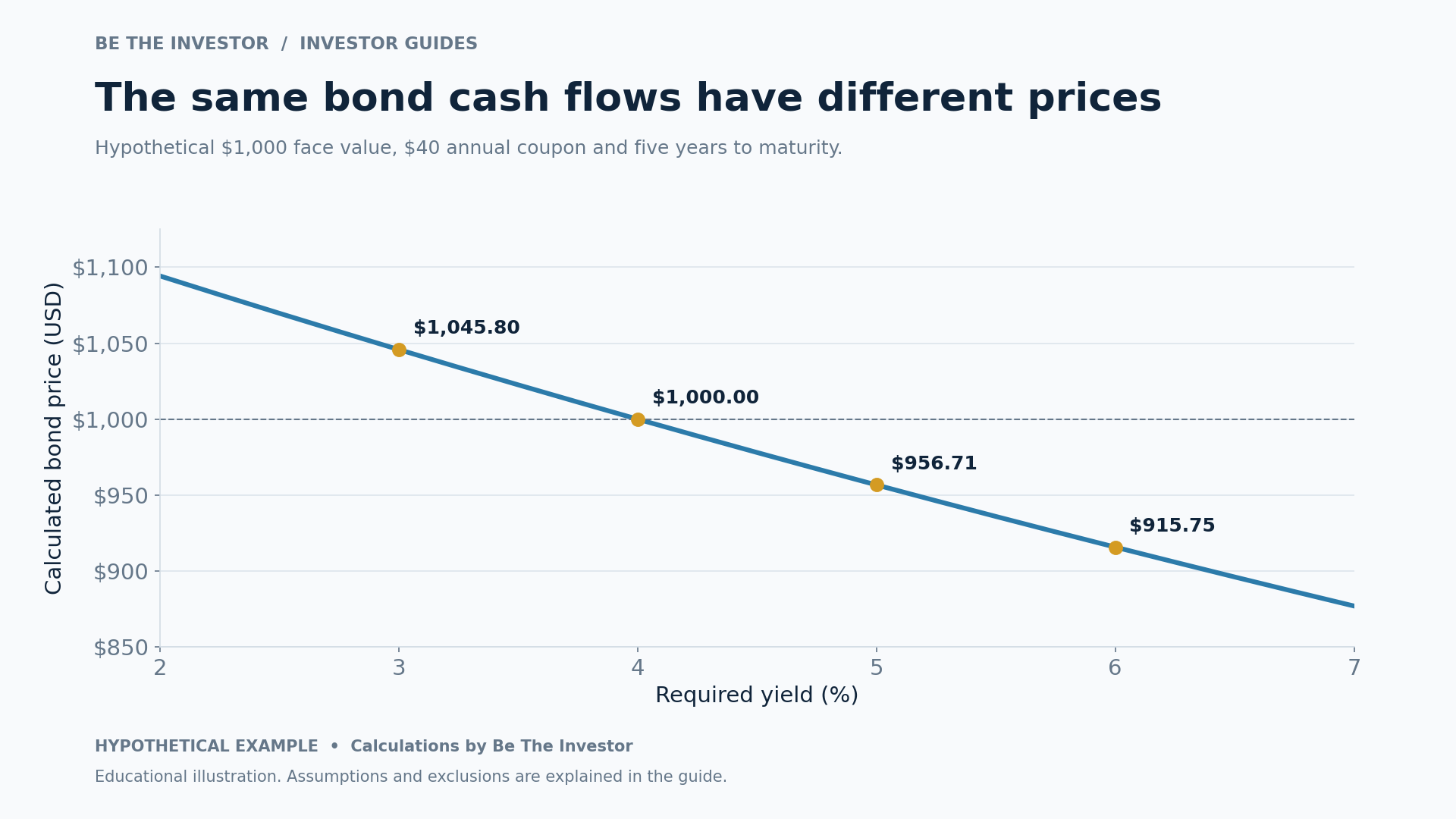
3. Worked example: price the same cash flows at different yields
Hypothetical assumptions: a bond has $1,000 face value, a fixed 4% coupon, five years remaining and one $40 coupon at each year-end. It pays the final $40 coupon plus $1,000 principal at the end of year five. Assume no default, no call option, no fees, no tax and settlement exactly on a coupon date. Annual payments make the teaching arithmetic simpler; actual securities may pay on another schedule.
Price = 40/(1+y) + 40/(1+y)2 + 40/(1+y)3 + 40/(1+y)4 + 1,040/(1+y)5. Here y is the annual required yield expressed as a decimal.
| Required yield | Calculated price | Annual coupon cash |
|---|---|---|
| 3% | $1,045.80 | $40 |
| 4% | $1,000.00 | $40 |
| 5% | $956.71 | $40 |
| 6% | $915.75 | $40 |
At a 5% required yield, the calculated price is $956.71. Current yield is $40 divided by the unrounded price, approximately 4.18%. Yield to maturity is 5% by construction. The difference is explained by the scheduled receipt of $1,000 at maturity after paying less than $1,000 today, together with the timing of all payments.
The example also shows why buying a bond at par is not inherently safer than buying below par. Price relative to par does not establish credit quality. A distressed bond may trade far below par because investors doubt repayment, while a sound low-coupon bond may trade below par simply because market yields increased.
4. Use duration to measure rate sensitivity
Maturity is a date. Duration is a measure related to cash-flow timing and price sensitivity. Modified duration estimates the percentage price change for a small change in yield. Effective duration is often used when cash flows can change with rates, such as callable or mortgage-related securities. Check which measure the source reports.
Approximate price change = −modified duration × change in yield. Express the yield change as a decimal.
The hypothetical five-year bond above has a calculated modified duration of approximately 4.40 at a 5% yield. An immediate increase in yield from 5% to 6% implies an approximate price change of −4.40%. Exact repricing gives a decline from $956.71 to $915.75, about −4.28%. The approximation differs because the price-yield relationship is curved, a feature called convexity.
This is an instantaneous price shock, not a full one-year return forecast. A holding-period return also includes coupon income, time passing, reinvestment and any change in credit spreads. For a fund, holdings and duration can change. FINRA's duration explanation is a useful reference for interpreting the measure without treating it as a complete risk score.
A short-duration bond can still have substantial default or liquidity risk. Conversely, a high-quality government bond can have significant price volatility if its duration is long. Credit quality and duration belong in separate columns of your research sheet.
5. Separate interest-rate risk from credit-spread risk
A corporate bond's required yield includes compensation for risks beyond the relevant government yield curve. Credit spread is commonly measured relative to a benchmark, although embedded options require more careful comparisons. The spread may widen when investors become more concerned about the issuer or less willing to hold risky debt.
Hypothetical scenario: a bond begins at a 6% yield, described approximately as a 4% benchmark yield plus a 2 percentage point credit spread. The benchmark falls to 3.5%, but the spread widens to 3%. Its total required yield rises to 6.5%. The bond can therefore lose value even while government yields fall.
This is why a weak corporate borrower is not a clean substitute for government debt in a defensive allocation. Read debt maturities, interest coverage, cash generation, covenants and refinancing needs. A credit rating helps organize the inquiry but is not a guarantee or a substitute for it. FINRA's due-diligence guidance also directs investors toward transaction and liquidity information.
6. Compare an individual bond with a bond fund
An individual noncallable bond has a defined maturity and contractual repayment amount, subject to default and its terms. A conventional open-ended bond fund continually holds and replaces securities. Its shares usually have no single date on which a fixed principal amount must be returned to you.
A fund can provide easier diversification and daily trading, but its net asset value moves with the portfolio. A fund holding government bonds can lose value when rates rise. Distribution yield is not a guaranteed total return. The SEC's bond-fund guidance explains why credit, rate and prepayment risk remain relevant.
Target-maturity bond funds are a separate structure. They may wind down around a stated year, but the amount returned is not a guaranteed par payment. Read the liquidation policy, default exposure and treatment of cash near termination. Similarly, holding an individual bond to maturity does not erase the opportunity cost of changing rates or protect the purchasing power of nominal principal.
To compare funds, use duration, credit quality, sector mix, currency, expenses, liquidity, distribution policy and a consistently defined yield measure. Do not compare one fund's trailing distribution yield with another's standardized yield as if they measured the same thing. The ETF selection guide covers the wider comparison process.
7. Include inflation, currency and reinvestment
A nominal payment can arrive exactly as promised while buying fewer goods. Inflation-linked securities address a particular inflation index and contract; they do not remove every source of market risk. TreasuryDirect describes how U.S. TIPS principal adjusts and how the maturity floor works. That floor refers to original principal, not necessarily a higher price you paid in the secondary market.
Currency creates another layer. A dollar bond held by someone whose future expenses are in another currency has a local-currency result affected by the exchange rate. Listing a fund in a particular trading currency does not by itself eliminate the underlying currency exposure. A hedged share class has its own costs and residual risks.
Reinvestment risk matters when coupons, calls or maturing bonds return cash. Falling yields may increase the price of existing fixed-rate bonds while reducing the rate available on new purchases. A bond ladder spreads maturities across dates, but does not guarantee a return or remove issuer risk. Match the cash-flow schedule to the purpose of the allocation.
8. Practice using an issuer's documents
Open Vanguard's official BND product page as a document-navigation exercise. Find the prospectus and fact sheet, then record the dates attached to duration, yield, holdings and expenses. Identify the types of bonds permitted and the principal risks. This is an example of where to research a listed fund, not a recommendation to buy it.
Do not copy today's product figures into an undated long-term assumption. The examples in this guide do not describe BND's actual yield, duration, price or expected return. Repeat the same document exercise for any alternative under consideration and compare observations with matching dates and definitions.
Bond research checklist
- Purpose: income, a dated spending need, diversification or a deliberate rate exposure?
- Contract: principal, currency, coupon type, payment dates, maturity and redemption options.
- Price: clean quote, accrued interest, commissions, markup and actual settlement amount.
- Yield: current yield, yield to maturity, call scenarios and reinvestment assumptions.
- Rate exposure: the reported duration measure and an explicitly assumed yield shock.
- Credit exposure: issuer cash generation, debt maturities, seniority and refinancing risk.
- Implementation: bid-ask spread, recent trades, minimum trade size and ability to sell.
- Portfolio fit: overlap, currency, tax circumstances and a documented review date.
A completed research note should explain where the return is expected to come from and which risk compensates you for receiving a higher yield. If that explanation is missing, the highest displayed yield is only a number.
Frequently asked questions
Can a bond lose money if the issuer keeps paying?
Yes. Its market price can fall as required yields rise, so selling before maturity can realize a loss. Inflation, currency movement and paying above the redemption amount also affect the result.
Is a 5% coupon a 5% investment return?
No. The coupon applies to face value. Your return depends on the price paid, the payment schedule, reinvestment, repayment and costs. Current yield and yield to maturity help analyze those differences.
Does a bond ETF pay back my original investment at maturity?
A conventional bond ETF generally has no single contractual maturity for your shares. Its portfolio changes over time and you sell at the prevailing market price. Target-maturity structures have different mechanics but still do not guarantee your original investment.
Does low duration mean low risk?
It means lower estimated sensitivity to small rate changes, other things equal. It does not resolve default, spread, liquidity, inflation or currency risk.
Should I buy bonds because I expect rate cuts?
A rate forecast alone is incomplete. The relevant yield curve may already reflect that expectation, credit spreads can move in the other direction, and the position may not match your horizon. Write the assumed yield change and its portfolio consequence before making a decision.
Disclosure: Educational information only. Hypothetical calculations are simplified and exclude costs and taxes unless stated. They are not personalized investment advice, a recommendation or a guarantee.
Continue your investor learning path
Use the investor guides learning path to choose your next topic and connect this research step with your investment plan.
Sources and further reading
Primary research sources checked on November 6, 2026. Open the original documents again before making a decision based on information that may change.
Cover photograph: Photo by Thuan Vo on Pexels. Used under the Pexels License.
Continue your BND research
Frequently asked questions
What is "Bond Investing: Price, Yield, Duration and Credit Risk" about?
Learn bond pricing, coupon versus yield, duration and credit risk with a worked example, plus a practical checklist for individual bonds and bond ETFs.
Which stocks and assets does this article cover?
This article relates to BND.
What is the market context?
A bond's coupon tells you its scheduled interest payment. It does not tell you the return you will earn at today's purchase price. A useful bond decision connects the cash-flow contract with the price, the issuer's ability to pay, your holding period and the currency in which you will eventually spend the money. This guide shows how to read those pieces together, price a simple bond, estimate…
When was this article published?
It was published on 06 / 11 / 2026 by Be The Investor Research.