



 Be The Investor Research
Neocloud Selloff Exposes the Financing Risk Behind AI Expansion

CoreWeave, Nebius and IREN extended losses after Gartner warned that AI infrastructure spending could outpace revenue, while CoreWeave's discounted debt showed stress beyond the stock market.
The selloff in AI infrastructure specialists moved beyond a routine growth-stock wobble after Gartner warned that the economics of planned capacity may not support every provider. CoreWeave fell 15.5% in regular trading before another reported 4% overnight decline, while Nebius and IREN also weakened.
Gartner expects AI providers to spend nearly $1 trillion on infrastructure in 2026 and another $6 trillion from 2027 through 2030. It estimates that more than 80% of neocloud providers could cease operating independently by 2030 as cost pressure and limited differentiation force sales, mergers or failures. Gartner also said more than $3.5 trillion of AI infrastructure spending could be exposed to impairment.
The forecast is not a prediction that 80% of today's listed companies will disappear. "Neocloud" covers a wider group of GPU-focused infrastructure providers, and ceasing independent operations can include acquisition. Gartner separately expects neoclouds to capture 20% of a $267 billion AI cloud market by 2030, so the warning combines market growth with consolidation risk.
CoreWeave's debt added a harder signal. The source reported that some unsecured notes due in 2032 traded below 80 cents on the dollar with yields above 15%. That is a higher hurdle than an equity valuation reset because refinancing becomes more expensive precisely when providers need capital for data centers, chips and power.
Chief Executive Mike Intrator told employees that the market reaction was irrational, according to the report. ARK Invest bought 188,665 CoreWeave shares for about $14.7 million, showing that some investors viewed the decline as an opportunity. Neither action resolves the cash-flow question.
For CoreWeave, Nebius and IREN, contract duration, customer concentration, debt maturities and power availability matter more than the headline size of AI demand. A fast-growing market can still destroy equity value if capacity is financed at costs that the resulting revenue cannot cover. Gartner's report makes that financing spread the central risk to monitor.
Continue your CRWV research
Related News

Gartner's Neocloud Warning Puts Financing, Not Demand, at Center Stage
Gartner expects more than 80% of neocloud providers to lose independent status by 2030. The risk is a mismatch between heavy infrastructure spending and cash earned before chips age.

Three Stocks Hit New Lows, but the Risks Were Very Different
EyePoint, CoreWeave and Eos Energy touched new lows on the same day. The selloffs reflected three distinct problems: a failed pivotal trial, financing pressure and manufacturing execution risk.

Gartner Sees a $4.9 Trillion Revenue Gap Behind the Neocloud Shakeout
Gartner estimates AI data-center owners need $8.5 trillion of revenue through 2030, against no more than $3.6 trillion available. The gap points to consolidation, not the disappearance of AI demand.

Gartner’s AI Infrastructure Math Puts Neocloud Survival Under Pressure
Gartner’s warning is less about an imminent collapse than a financing mismatch: AI infrastructure owners may need far more revenue than the market can generate before today’s accelerators lose value.

AI Stocks Rebound After a Rate Shock, but Valuation Risk Remains
A broad technology rebound followed a sharp AI selloff driven by rising yields and profit-taking. The recovery can last only if earnings support the spending and valuation assumptions already embedded in prices.

CoreWeave’s Upgrade Rests on Scale, but Debt Still Defines the Risk
Goldman Sachs upgraded CoreWeave as its backlog and operating scale expanded. The bullish case depends on turning contracted demand into cash faster than financing and depreciation consume it.
Chip Stocks Snap a Nine-Day Slide as Investors Reprice AI Risk

Semiconductor stocks finally found buyers after nine consecutive down sessions, lifting the broader technology market and helping the Nasdaq recover from its worst week in months. The reversal matters because chips had become the clearest expression of anxiety about AI spending, high interest rates and stretched expectations.
The pressure built quickly. The semiconductor ETF tracked in the source had fallen 3.4% on Friday, while CoreWeave lost 11.9% and the Nasdaq Composite dropped 2.1%. For the week, the Nasdaq was down roughly 4.5%. The 10-year Treasury yield near 5.1% added another challenge because higher discount rates reduce the present value of profits expected far in the future.
Monday’s rebound suggests that forced selling and short-term risk reduction had run far enough to attract capital. It does not settle the fundamental argument. Chipmakers and cloud providers are building for demand that customers expect to persist for years, while the hardware itself can be overtaken by a new generation within a much shorter period. That creates a timing problem: utilization and pricing must remain strong enough to recover investment before the equipment loses economic value.
The next stage of the trade will depend less on broad AI enthusiasm and more on company-specific evidence. Investors should compare order growth with inventory, gross margins and customer concentration. They should also watch whether hyperscalers maintain capital-spending plans and whether those investments produce faster cloud revenue or measurable customer savings.
The rebound is constructive because it shows the market has not abandoned the AI theme. Yet it also marks a shift from narrative to proof. Semiconductor shares can recover sustainably if demand remains broad, margins hold and customers demonstrate returns. If earnings reveal slower orders or another jump in spending without matching revenue, the nine-day decline may look like the beginning of a longer valuation reset rather than an isolated correction.
Nasdaq Rebound Ends a Brutal AI Week, but Expectations Still Set the Risk
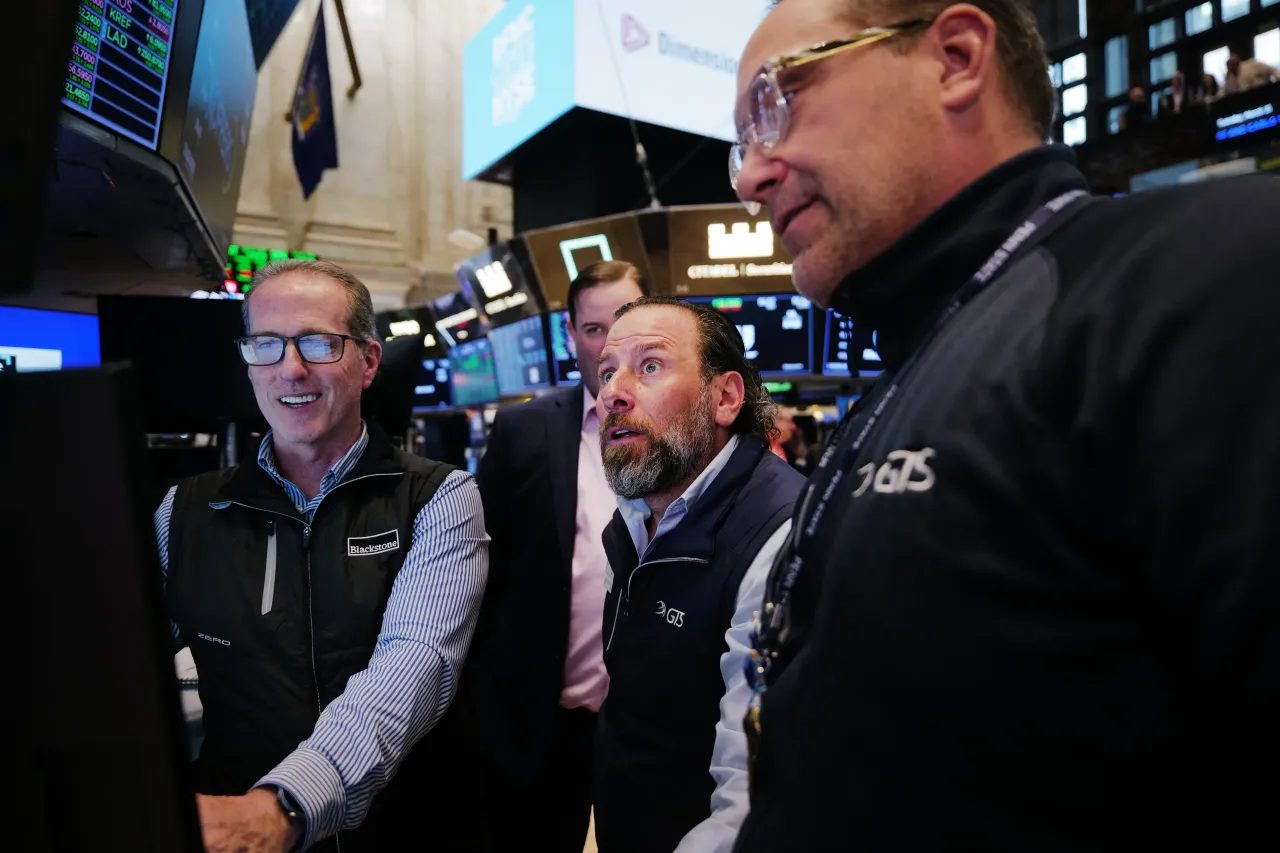
Technology shares rebounded sharply on Monday, giving the Nasdaq 100 its best day in nearly a month after a week that punished many of the market’s most crowded AI trades. Amazon, Apple and Palantir rose, while CoreWeave and other volatile infrastructure names recovered part of their recent losses. The move was broad enough to cool fears that the prior week’s decline had become a disorderly exit.
One session does not erase the damage. The Nasdaq Composite had fallen about 4.5% in the previous week, and semiconductor shares had endured a nine-session losing streak. CoreWeave, a focal point in the debate over AI capital spending, had dropped nearly 12% on Friday alone. Monday’s gains therefore looked partly like short-covering and bargain hunting after a rapid repricing.
The more durable support came from earnings. According to LSEG figures cited by CNBC, 47 S&P 500 companies had reported by Monday morning and 85% had beaten earnings estimates. Blended earnings growth was running near 29%. That is a strong start, but it also explains why investors are unforgiving: valuations embed continued profit growth, especially among the largest technology companies.
The key question is whether the rebound can move beyond a handful of megacaps and speculative AI names. A healthier recovery would combine stronger market breadth with company results that validate capital spending. For Amazon and other hyperscalers, investors need evidence that cloud and AI revenue can scale alongside depreciation and data-center costs. For infrastructure providers such as CoreWeave, financing costs and the pace of capacity delivery matter as much as booked demand.
The day’s rally is therefore best read as a reset in positioning, not proof that the AI correction has ended. Upcoming megacap earnings can support the market if revenue, margins and guidance justify expectations. They can also expose the same asymmetry that drove the selloff: when forecasts are already optimistic, even solid results may not be enough.
Microsoft's Maia 300 Is an Efficiency Bet, Not an Nvidia Exit
Microsoft plans to make its Maia family the primary inference system for its own products and services as it begins multi-gigawatt deployments in 2027. That is a meaningful change in infrastructure strategy, but it is not evidence that Microsoft is abandoning Nvidia.
Maia 200 is already serving production workloads including Microsoft Copilot and is being deployed in the United States, Europe and Australia. Microsoft says it runs OpenAI models, the company's own MAI models and leading open-source families.
Maia 300 is due to enter production deployments in 2027. Microsoft expects the system to deliver 40% more tokens per megawatt than leading GPU-based systems and up to seven times Maia 200's rack-scale token throughput in a 96-accelerator configuration. The design uses eight HBM4 memory stacks per accelerator, 18 terabytes per second of peak memory bandwidth and a 950-watt thermal envelope.
Those are Microsoft-defined comparisons, not independent benchmarks. The company did not publish a direct comparison with Google's tensor processing units, and workload mix can materially change tokens-per-watt results. Investors should treat the figures as engineering targets until customers and third parties can test them at scale.
The economic logic is straightforward. Inference is becoming a recurring cost across Copilot, GitHub, Teams and Azure services. A custom system optimized around Microsoft's own workloads could lower power use and reduce the share of value paid to outside chip vendors.
That does not make Nvidia optional. Microsoft describes Azure as a heterogeneous platform and says it will continue to use innovations from across the ecosystem. Training frontier models, serving diverse customer workloads and meeting rapid capacity growth require more than one accelerator family.
Maia therefore changes Microsoft's bargaining position and internal cost curve before it changes the competitive map. If the chip performs as expected, Microsoft can direct suitable inference workloads to its own silicon while reserving GPUs for tasks where they remain the better fit.
The real test will arrive after deployment begins: utilization, service reliability, power efficiency on production workloads and changes in capital spending per unit of AI output. Until then, Maia 300 is a credible efficiency program with strategic value, not proof that Microsoft has closed the gap with Nvidia or Google.
Adobe's AI Usage Is Growing Faster Than Its Backlog
Adobe's fiscal third quarter offered evidence that customers are using its AI products at scale. It also left investors with a harder question: how quickly will that usage convert into durable contracted revenue?
Revenue rose 13% as reported to $6.76 billion, and non-GAAP earnings per share reached $6.13. Adobe raised its full-year targets to $26.576 billion to $26.626 billion of revenue and $24.45 to $24.50 of non-GAAP EPS.
The strongest operating signal came from AI adoption. AI-first annual recurring revenue exceeded $650 million and grew more than 150% from a year earlier. Firefly ending ARR from the app and credit packs increased 40% from the prior quarter. Creative freemium monthly active users passed 100 million, up more than 70%.
Those figures show reach, but they measure different stages of the funnel. Freemium users indicate product exposure. Credit consumption shows activity. ARR shows contracted or recurring monetization. Investors need all three to rise without heavy discounting or damage to Adobe's high-margin subscription model.
The counterpoint is remaining performance obligations, which grew 8% to $22.16 billion. Current RPO rose 9%. Both were slower than reported revenue growth, which can indicate that the future contracted base is not accelerating as quickly as current usage. It is not a forecast of decline, but it explains why the market remains skeptical despite solid quarterly results.
Cash generation stayed strong. Operating cash flow reached a quarterly record of $2.52 billion, and Adobe repurchased about 9.5 million shares. The company had approximately $24.55 billion left under its April 2026 buyback authorization.
Leadership is also changing. Anil Chakravarthy becomes president and chief executive on Dec. 1, while Shantanu Narayen moves to executive chair. Chakravarthy inherits a company with a large installed base and fast-growing AI engagement, but also pressure to prove that generative tools expand Adobe's economics rather than commoditize creative work.
The next phase is therefore about conversion. Adobe must turn free users into paying customers, grow Firefly and agentic products without eroding core pricing, and lift net new ARR. The quarter showed that AI demand exists inside Adobe's ecosystem. It did not yet settle how valuable that demand will be.
Rocket Lab's Iridium Deal Faces an FCC Competition Challenge
Rocket Lab's proposed $8 billion acquisition of Iridium has drawn a competition challenge at the Federal Communications Commission, adding another uncertainty to a company already managing a delay to its Neutron rocket.
Ligado Networks asked the FCC to examine whether Iridium has used regulatory filings to slow competing satellite services. Ligado has a direct commercial interest: its planned SkyTerra Next service with AST SpaceMobile would use satellite connectivity for direct-to-device communications and could compete with Iridium.
The filing does not amount to an FCC finding. It is an allegation from an interested party in an active proceeding, and Rocket Lab and Iridium will have an opportunity to respond. Investors should distinguish that process from a rejection or a formal enforcement action.
The underlying transaction is much larger than a spectrum dispute. Rocket Lab agreed in June to pay $54 per Iridium share in cash and stock, valuing the company at about $8 billion including debt. Iridium brings a global L-band network, more than 2.55 million active subscribers, over 500 distribution partners and recurring communications revenue. Rocket Lab would add those assets to launch, spacecraft manufacturing and satellite components.
That vertical integration could lower launch costs for a future Iridium constellation and give Rocket Lab immediate exposure to direct-to-device, Internet of Things and positioning services. It also increases execution risk. The deal requires regulatory approvals, financing and the integration of a profitable network with a capital-intensive launch company.
Neutron makes the timing harder. Rocket Lab moved the medium-lift rocket's first flight into 2027 after identifying manufacturing defects in a carbon-composite propellant-tank component. Neutron is central to the logic of launching larger constellations internally, so further delays could postpone some expected benefits even if the acquisition closes.
Rocket Lab shares had fallen about 25% over the prior week and 38% from the Oct. 7 close reported by the source. Price action reflects both issues, but they should be monitored separately. Neutron is an engineering and schedule risk. The Iridium proceeding is a regulatory and competitive risk.
The FCC challenge is not proof that the transaction will fail. It does mean the public-interest case will receive closer scrutiny, especially around spectrum and competitor access. For investors, the next evidence is the applicants' response, the FCC timetable and whether Neutron's revised tests support a credible 2027 launch plan.
Latest comments