


 Be The Investor Research
Lucid Buys Time, but Its $1.75 Billion Lifeline Does Not Fix Demand
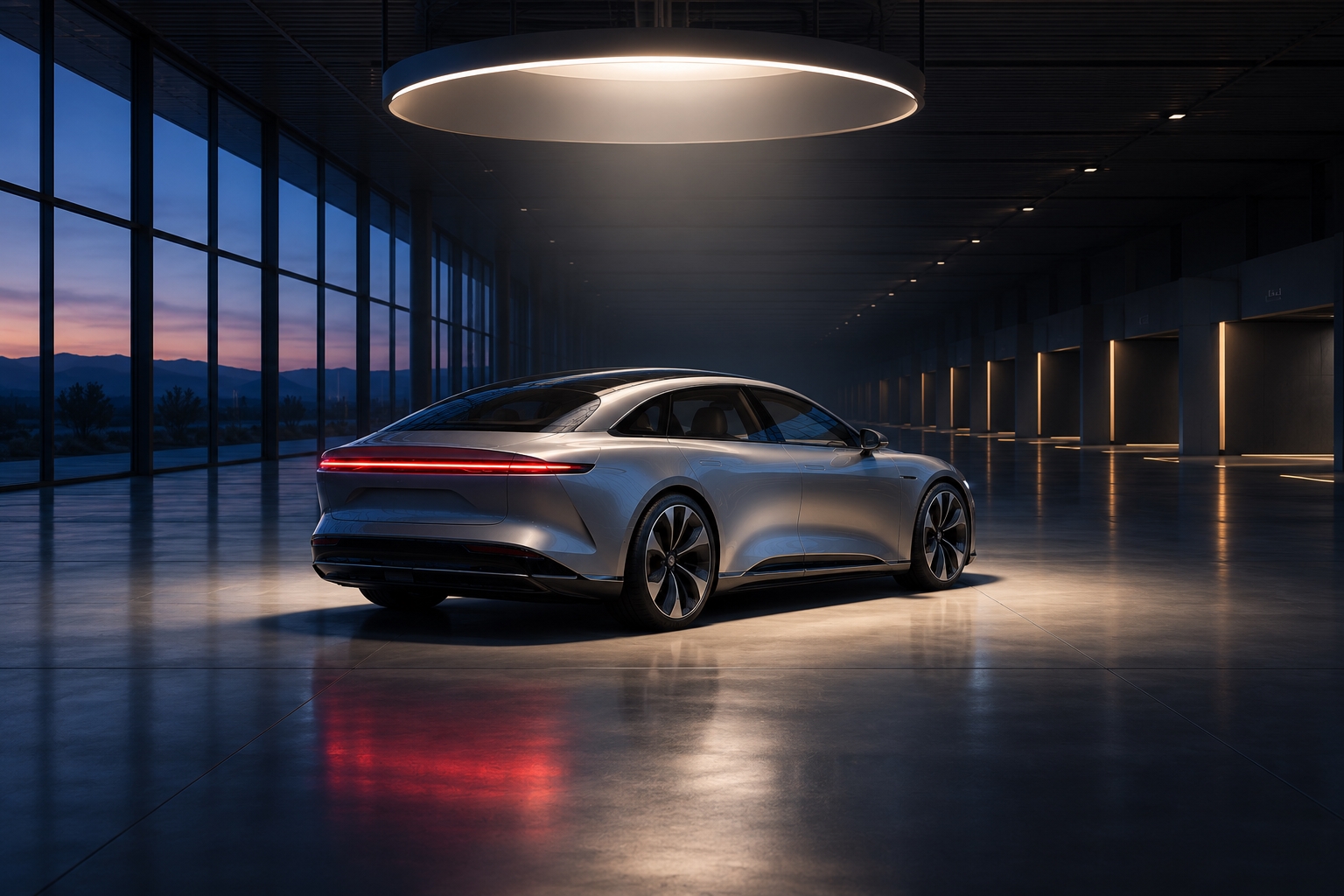
Lucid cut quarterly cash burn by 30% and secured another $1.75 billion from Saudi Arabia's PIF. The funding extends its runway into late 2027, but weak deliveries and heavy losses keep execution risk high.
Lucid's latest Saudi funding gives the electric-vehicle maker more time to complete its turnaround, but it does not resolve the basic problem: the company is still spending far more cash than it generates while deliveries remain under pressure.
The Public Investment Fund increased Lucid's delayed-draw term loan facility by $1.75 billion. Lucid said the expansion lifts pro forma liquidity to $3.75 billion from $2.0 billion at September 30 and should fund operations and key investments into the fourth quarter of 2027. That timing matters because production of Lucid's midsize vehicle remains planned for the second half of 2027, leaving little room for another major delay.
The third quarter did show measurable cost progress. Free cash flow consumption fell 30% from the second quarter to $1.04 billion from $1.48 billion. Lucid said it had captured $0.8 billion of savings through September under a $1.4 billion full-year cash-flow improvement plan. Revenue reached $350 million, up 4% from a year earlier, and the company reported a smaller gross loss than in the prior quarter.
Demand is still the harder test. Lucid delivered 3,806 vehicles in the quarter, 7% fewer than a year earlier. Revenue of $350.3 million also missed the roughly $399 million consensus cited in the original coverage, while the adjusted loss of $2.30 a share was wider than the $2.21 estimate. Net loss narrowed to $830.9 million from $978.4 million, but that remains more than twice quarterly revenue.
Management is trying to create demand beyond direct consumer sales. Lucid said its autonomy partnership with Uber and Nuro had more than 100 vehicles on the road by the end of the quarter, while a separate Bolt partnership targets at least 25,000 vehicles. Its Saudi assembly plant entered the final stages of industrialization, with inauguration expected in early 2027. Those programs could improve utilization, but fleet targets and commissioning milestones are not yet evidence of profitable volume.
The balance sheet also carries more than the headline liquidity number suggests. The original reports cited about $4.9 billion of debt and loans in early October, plus a $3.07 billion liquidation preference on redeemable convertible preferred stock at June 30. Lucid may need further debt, equity-linked funding or support from the PIF if midsize production slips or demand remains weak.
Analysts cutting price targets to $9 and $4 reflect that uncertainty, but the operational milestones are more useful than target prices. Investors should watch quarterly cash consumption, vehicle deliveries, the pace of Saudi plant commissioning and whether the midsize program reaches pilot and production dates without consuming the new facility too quickly.
Image references: · Lucid (Official factual background)
Frequently asked questions
What is "Lucid Buys Time, but Its $1.75 Billion Lifeline Does Not Fix Demand" about?
Lucid cut cash burn and gained $1.75 billion of PIF support, but weak deliveries and large losses still put its 2027 midsize launch at risk.
What is the market context?
Lucid's latest Saudi funding gives the electric-vehicle maker more time to complete its turnaround, but it does not resolve the basic problem: the company is still spending far more cash than it generates while deliveries remain under pressure. The Public Investment Fund increased Lucid's delayed-draw term loan facility by $1.75 billion. Lucid said the expansion lifts pro forma liquidity to $3.75…
When was this article published?
It was published on 11 / 11 / 2026 by Be The Investor Research.