



Carvana can sell more cars in a flat market. A downturn is a different test
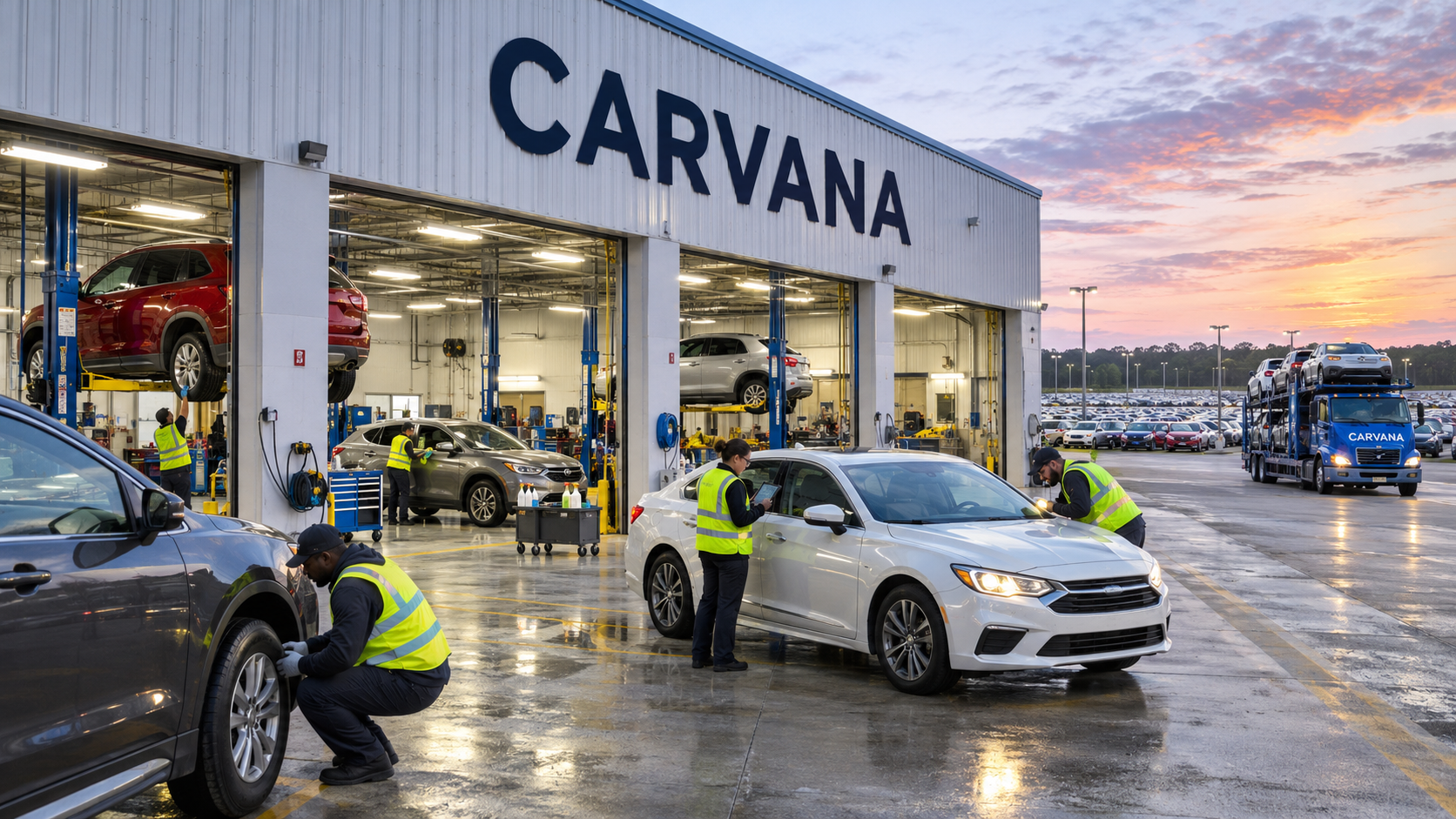
Carvana's retail sales grew 39% in the September quarter despite a flat used-car market. More reconditioning capacity and stronger cash reserves help, but lower profit per vehicle shows how quickly fuel and financing costs can bite.
Carvana sold 217,385 vehicles to retail customers in the September quarter, its first quarter above 200,000. That was 39% more than a year earlier even though management described the broader used-car market as roughly flat. The company says its main obstacle is finding and preparing enough cars to sell. That explanation fits the recent growth, but it does not tell investors what will happen if used-car demand contracts rather than merely stands still.
Management said on October 28 that Carvana had grown retail sales by about 40% for eight straight quarters. The selection of cars immediately available on its website has grown more slowly than sales. To close that gap, Carvana added inspections and reconditioning at its existing ADESA Orlando auction site. Preparing cars at an auction it already operates adds inventory to the retail network without building a separate site; Carvana said the expansion would add about 100 jobs. Higher capacity helps while demand is there. If cars start taking longer to sell, having more of them ready ties up more cash.
Revenue rose 42% to $8.04 billion and net income reached $483 million, up $220 million from a year earlier. Adjusted earnings before interest, taxes, depreciation and amortization rose to $800 million from $637 million. But as a share of sales, adjusted EBITDA fell to 10.0% from 11.3%. Adjusted EBITDA per retail vehicle fell from about $4,085 to $3,680. More cars sold meant more dollars of profit, not more profit per car.
Carvana's reported total gross profit per retail vehicle fell $365 to $6,997. The gross profit from the cars themselves rose $100 per vehicle, while the category that includes gains from selling loans fell $307. Management chose to offer borrowers rates that were more competitive relative to benchmarks. It estimated that higher fuel prices and benchmark rates together cost about $200 per unit. Those two figures overlap in part and should not be added to estimate the total hit.
Two peers help explain the risk without predicting Carvana's results. CarMax's comparable-store used-car sales rose 13% in the quarter ended August 31, but its gross profit per used vehicle fell $111 to $2,105 after pricing changes. Credit Acceptance lowered its expected net cash flows from loans by $291.2 million, primarily because it changed its forecasting method. That was not a realized loss of collections or evidence that Carvana's borrowers had deteriorated. It does show why the prices investors will pay for loans deserve attention alongside vehicle sales.
Carvana entered this period in a stronger position than when sales were last contracting. Trefis calculated that revenue fell 23% and operating margin was minus 4.4% in the 12 months to September 2023. For the 12 months to September 2026 it calculated $2.4 billion of operating profit on $27.5 billion of revenue, or 8.7%. The filings show $3.049 billion of cash and equivalents at September 30, 2026, plus $123 million of restricted cash, versus $544 million of cash and equivalents and $72 million of restricted cash three years earlier. On the same balance-sheet debt definition, borrowings fell from about $5.93 billion to $5.23 billion, excluding lease liabilities.
Carvana refinanced the last $1.7 billion of its 2030 senior secured notes with a term loan in the third quarter. Management estimates annual interest savings of about $45 million. Its own net debt measure was 0.8 times trailing adjusted EBITDA, and trailing adjusted EBITDA covered interest expense 6.9 times. Trefis's operating-income coverage of 6.1 times uses a different numerator. Its $1.11 billion trailing free cash flow estimate is a trailing measure, not a promise that the next year's cash will be as strong. The company plans to assess its three-million-vehicle annual goal using a 12.5% reported operating margin beginning in 2027, replacing its prior 13.5% adjusted EBITDA margin target. The reported target applies to the 2030 to 2035 window.
TIKR put the October 26 to November 2 share gain at about 27%, from $56.61 to $72. Earlier selloffs went the other way: in Trefis's tariff-shock comparison Carvana dropped 42% versus 19% for the S&P 500; in its 2022 inflation comparison it dropped 94% versus about 25%. Those snapshots show the stock's sensitivity, not the likelihood of another drawdown.
For the December quarter, management expects to sell more retail vehicles than in September and to reach the high end of its $2.7 billion to $3.0 billion 2026 adjusted EBITDA range, assuming the market remains stable. The next report is expected in February 2027. If growth slows, the first useful distinction will be whether Carvana ran short of cars buyers wanted or had to offer lower prices and cheaper financing to move the cars it already had.
Continue your KMX research
Image references: · מקור ייחוס · מקור ייחוס · מקור ייחוס · מקור ייחוס
Frequently asked questions
What is "Carvana can sell more cars in a flat market. A downturn is a different test" about?
Carvana has more cash and refinanced debt, but its record quarter shows where higher credit and fuel costs could pinch when used-car demand softens.
Which stocks and assets does this article cover?
This article relates to KMX, CACC.
What is the market context?
Carvana sold 217,385 vehicles to retail customers in the September quarter, its first quarter above 200,000. That was 39% more than a year earlier even though management described the broader used-car market as roughly flat. The company says its main obstacle is finding and preparing enough cars to sell. That explanation fits the recent growth, but it does not tell investors what will happen if…
When was this article published?
It was published on 17 / 11 / 2026 by Be The Investor Research.