


 Be The Investor Research
Liquidia's Rally Reflects Relief, but Analysts Still Disagree on the Ceiling

Analysts broadly welcomed Liquidia's settlement with United Therapeutics because it preserves YUTREPIA in PAH. Their divergent targets show that lost PH-ILD access and a $380.7 million payment still shape valuation.
Liquidia's sharp rally after settling with United Therapeutics was a relief trade, not a unanimous verdict on long-term value. The agreement protected YUTREPIA's continued sale in pulmonary arterial hypertension, removing a scenario that could have impaired the company's main commercial asset.
BTIG called the outcome better than its best-case scenario and upgraded Liquidia to Buy with a $70 price target, according to the original analyst roundup. Wells Fargo lifted its target to $33 but kept an Equal Weight rating. Needham reduced its target from $72 to $58 even while viewing the removal of legal risk favorably. The dispersion is more informative than any single number.
The optimistic case rests on PAH growth. Preliminary third-quarter YUTREPIA sales were $222.7 million, up about 31% sequentially, and analysts can now model that market without assigning a large probability to a product-blocking court outcome. Liquidia also retains upside from its late-stage L606 program.
The cautious case starts with what the settlement costs. Liquidia will pay a net $380.7 million in installments through 2027 and stop promoting YUTREPIA for PH-ILD. That removes a source of future sales and absorbs cash during a period when the company still needs to fund commercial expansion and research. A higher sales forecast does not automatically produce a higher equity value if more cash leaves the business.
United Therapeutics also benefits. It receives settlement payments and a clearer position for Tyvaso in PH-ILD, while continuing to compete with YUTREPIA in PAH. That split explains why analysts can call the agreement favorable to both companies for different reasons.
After the initial repricing, Liquidia's valuation will depend on execution rather than courtroom probabilities. Investors should compare quarterly PAH prescription growth with cash outflows, monitor gross margin and track progress on L606. Analyst targets are useful as scenario maps, but the widening range shows that the next debate is about commercial scale and cash conversion.
Continue your UTHR research
Related News

Oklo's 63% Drop Leaves Licensing and Funding as the Real Tests
Oklo's selloff has reduced expectations, but the company still needs regulatory progress, project financing and binding customer commitments before its nuclear thesis becomes operating cash flow.

Qualcomm's Selloff Puts Its Diversification Plan on Trial
Qualcomm's 13% monthly decline reflects handset and Apple exposure, while management is asking investors to look toward automotive, industrial computing and a new data-center business.

Devon's Rally Now Depends on Turning Merger Savings Into Cash
Devon's cash generation improved before its Coterra merger, but a negative reported free-cash-flow quarter makes delivery of $1 billion in promised annual synergies the next test.

Verizon's Customer Rebound Is Real, but the FCC Vote Could Reset Wireless Risk
Verizon added 406,000 postpaid phones and raised guidance, proving its turnaround has operating traction. An October 29 FCC vote on satellite spectrum could still reshape the long-term competitive risk.

Incyte's $181 Scenario Requires Revenue to Nearly Double Without a Margin Collapse
A three-year Incyte scenario points to 56% upside, but it assumes 22.9% annual revenue growth and a still-high net margin. One-time Opzelura benefits make the starting point less clean.

SoundHound's Cash Runway Exceeds One Year, but Dilution Remains the Cost
SoundHound's revenue is growing quickly, yet quarterly cash burn reached $36.9 million before the LivePerson deal closed. Its November report must show whether integration can slow burn without another financing cycle.
AppLovin's 61% Slide Turns Its Next Quarter Into a Model Test
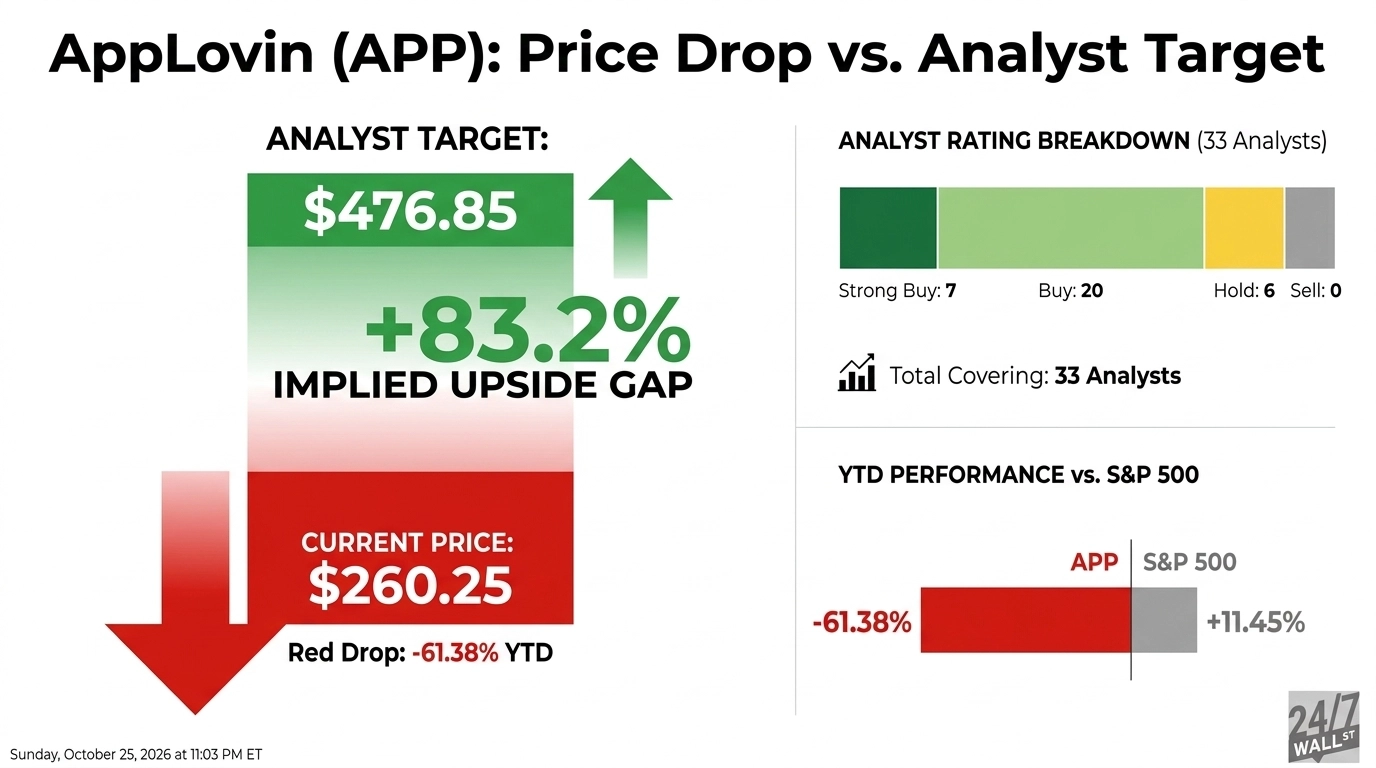
AppLovin's second-quarter results were strong in absolute terms, yet a small miss was enough to deepen a 2026 share-price collapse. The stock traded at $260.25 on October 26, according to 24/7 Wall St., down 61.38% for the year and close to its 52-week low. That reaction makes the next quarter a test of whether the setback was timing or a change in the growth engine.
The official results show why investors have not abandoned the company. Revenue rose 53% from a year earlier to $1.924 billion, net income increased 55% to $1.267 billion, and adjusted EBITDA climbed 58% to $1.614 billion. AppLovin generated $863.3 million of free cash flow and spent $551.3 million on share repurchases and tax withholding tied to vested awards.
The problem was the gap between a fast-growing business and even higher expectations. The source report says revenue missed estimates by 0.94%, while adjusted EBITDA fell below the guided range as computing costs rose. Chief Executive Adam Foroughi attributed the quarter's slower progress to the timing of model improvements, with the next meaningful upgrade arriving after quarter-end. Because AppLovin's AXON advertising system depends on repeated model gains, investors treated the timing issue as evidence that growth may be less predictable.
Management's third-quarter outlook points to continued expansion. The company guided for revenue of $2.055 billion to $2.085 billion and adjusted EBITDA of $1.710 billion to $1.740 billion, both with an 83% adjusted EBITDA margin at the midpoint and endpoints stated by the company. Meeting that range would show that the model improvement deployed after June is contributing to revenue. Missing it would strengthen the argument that the second-quarter stumble was not isolated.
The bullish case goes further. The source cites a $790 target from UBS analyst Stephen Ju, compared with a $476.85 average target across 33 analysts. Ju's view rests on AXON monetization, expansion from mobile gaming into e-commerce advertising, and free cash flow that can support buybacks. Those targets are opinions, not operating evidence, and even the consensus target implies a recovery that requires sustained execution.
There are also issues outside the quarterly model cadence. A securities class action challenges statements about model improvements, while the source says an SEC inquiry ended without a recommendation for enforcement action. The legal matters should not be treated as interchangeable. One remains active; the other, according to the report, closed without recommended action.
AppLovin is scheduled to report third-quarter results on November 4. Revenue, adjusted EBITDA margin and evidence of advertiser expansion will matter more than any price target. The company has already demonstrated high profitability and cash generation. It now has to show that those results can keep compounding when model upgrades do not arrive on a perfectly smooth schedule.
Alibaba's Cloud Growth Cannot Yet Offset Its Commerce and Cash Costs
Alibaba's 31% share-price decline in 2026 looks like a broad retreat from Chinese internet stocks, but the company's latest results show a sharper internal divide. Its cloud business is growing quickly, while core commerce and the cash cost of artificial intelligence investment remain meaningful constraints.
On October 26, 24/7 Wall St. reported Alibaba's U.S.-listed shares at $99.91, down 31% for the year. The KraneShares CSI China Internet ETF and PDD Holdings were each down about 32%, while JD.com was down 9% and the S&P 500 was up 12%. Those comparisons support the view that sector sentiment matters, but they do not show that Alibaba's businesses are standing still.
For the June 2026 quarter, Alibaba reported revenue of RMB268.95 billion, up 9% from a year earlier. AI Cloud and Compute Services revenue rose 45% to RMB48.44 billion, while AI-related product revenue reached RMB12.38 billion and posted triple-digit growth for a twelfth consecutive quarter. Segment adjusted EBITA increased 133% to RMB5.63 billion. Those figures provide the clearest evidence that cloud is becoming a larger and more profitable part of the group.
Commerce was less convincing. China e-commerce revenue fell 8%, and customer management revenue declined 7%. Alibaba said customer management revenue would have risen 1% on a like-for-like basis without the contra-revenue effect of a new business development program. China Quick Commerce revenue rose 45%, but that growth came alongside continued investment in user experience and technology.
The consolidated numbers show the cost of the transition. Reported operating income fell 57% to RMB15.16 billion, and net income declined 75% to RMB10.44 billion. Adjusted EBITA fell 30% to RMB27.33 billion. Free cash flow was an outflow of RMB44.67 billion, compared with an RMB18.82 billion outflow a year earlier, mainly because cloud infrastructure spending increased. Quarterly capital expenditure rose 75% to RMB67.68 billion.
Alibaba still had RMB474.51 billion of cash and other liquid investments at the end of June. That balance gives management room to fund AI infrastructure, but the spending has to translate into durable returns. The new AI Labs and Applications segment reported an adjusted EBITA loss of RMB13.86 billion, more than four times the RMB3.22 billion loss a year earlier, largely because of AI investment and Qwen app inference costs.
The investment question is therefore not simply whether Alibaba is cheap after falling with its peers. It is whether 45% cloud growth and improving cloud profitability can eventually outweigh slower commerce, heavy capital expenditure and rising application-layer losses. A sustained gap between Alibaba and the broader China internet index would be useful market evidence, but the stronger proof will come from cash flow and consolidated profit.
Meta's $135 Billion AI Budget Shifts Attention to Amphenol

Meta's artificial intelligence budget is now large enough to shape results well beyond Meta itself. Aptus Capital Advisors portfolio manager David Wagner argues that the spending should be viewed from both sides: capital expenditure for Meta becomes revenue for the companies supplying data centers, networking equipment and cloud capacity.
That argument gained firmer numerical support in Meta's third-quarter results. The company spent $34.91 billion on capital expenditures, including principal payments on finance leases, during the quarter and narrowed its full-year 2026 forecast to $135 billion to $145 billion. Meta also said its AI investments are already lifting advertising revenue through better recommendations, engagement and monetization.
The cost is visible too. Meta generated $32.79 billion of operating cash flow in the third quarter but reported negative free cash flow of $2.12 billion. It ended September with $82.45 billion of cash, cash equivalents and marketable securities. The company has since said it plans to fund its infrastructure with a mix of operating cash flow, investment-grade debt, strategic partnerships and equity capital. That makes Wagner's point about debt capacity more specific: Meta has substantial resources, but the buildout is big enough to require several funding channels.
Amphenol is one way investors can express the supplier side of that thesis. The company sells connectors, cables and related systems into the IT and data communications market, making it exposed to the physical expansion of AI infrastructure. Wagner named Amphenol alongside Amazon and Meta among stocks he favors. The connection is economically plausible, but it is not a guarantee that every dollar of Meta spending reaches Amphenol. Customer mix, component pricing, competition and the shift between copper and optical connections will determine how much of the industry budget becomes Amphenol revenue.
The next company-specific check arrives quickly. Amphenol is scheduled to report third-quarter results on October 28. Investors can then compare the broad supplier thesis with actual IT and data communications sales, orders and guidance. Meta's spending plan supports demand, while Amphenol's own results will show how much of that demand it is capturing.
Apparel Selloff Masks Three Different Turnaround Problems
A broad retail selloff pushed Lululemon and Under Armour down about 4% on October 23, while Nike fell roughly 2%. The similar share moves concealed three different operating problems, and investors should not treat the group as a single bet on consumer spending.
The macro backdrop was not uniformly weak. The U.S. Census Bureau estimated September retail and food-services sales at $745.0 billion, up 0.8% from August and 6.3% from a year earlier. The report was adjusted for seasonal and trading-day effects but not for price changes. With the SPDR S&P Retail ETF down about 2% that day and no fresh announcement from the three companies, the stock moves looked more like a repricing of discretionary risk than a response to new company results.
Lululemon has the clearest near-term demand problem. Second-quarter revenue fell 4% to $2.4 billion, Americas revenue declined 8%, and Americas comparable sales dropped 12%. Reported gross margin rose 200 basis points to 60.5%, but a $134.5 million tariff refund added 560 basis points. Operating margin still declined 190 basis points to 18.8%. Management guided third-quarter revenue to $2.29 billion to $2.32 billion, a 10% to 11% decline, and expects full-year revenue to fall 5% to 7%.
Under Armour's weakness is spread across channels and categories. Its first-quarter fiscal 2026 revenue declined 4% to $1.1 billion, with North America down 5%, wholesale down 5% and direct-to-consumer revenue down 3%. Footwear fell 14%, a sharper contraction than the 1% decline in apparel. The company reported $13 million of restructuring charges and held $911 million of cash, including $400 million raised in senior notes to help address $600 million of notes due in June 2026.
Nike is further along in parts of its turnaround, but the recovery is uneven. Fiscal first-quarter 2027 revenue fell 4% to $11.2 billion, while North America grew 2%. Performance categories grew at a high-single-digit rate, helped by running and global football, but Sportswear, Jordan and Greater China remained material drags. Nike ended the quarter with $8.4 billion in cash and short-term investments, giving it more financial room than the other two companies.
The October 23 selloff therefore did not prove that shoppers had suddenly stopped spending. It highlighted different tests: Lululemon must stabilize Americas comparable sales without relying on one-time tariff refunds, Under Armour must make restructuring produce durable demand and margin improvement, and Nike must turn strength in performance products into a broader brand recovery.
ARK's Archer and Joby Purchases Put Execution Ahead of Hype

ARK Invest's latest purchases of Archer Aviation and Joby Aviation are a visible vote of confidence in electric air taxis, but the size of the trades is less important than the operating milestones the two companies still need to deliver.
Stocktwits reported that ARK bought 1,161,604 Archer shares for about $4.5 million and 434,012 Joby shares for about $2 million. The purchases were spread across the ARK Autonomous Technology & Robotics ETF and the ARK Space Exploration & Innovation ETF. ARKQ received 781,854 Archer shares and 292,119 Joby shares, while ARKX added 379,750 Archer shares and 141,893 Joby shares.
Those transactions show how an active manager is positioning its funds. They do not establish that commercial demand, certification or unit economics have improved. ARKQ itself describes its strategy as actively managed, which means holdings can change as the portfolio team revises its views.
Archer has supplied a clearer operating narrative in Texas. The company announced plans for air-taxi networks in Austin, Dallas-Fort Worth and Houston, linking airports and other high-traffic destinations. Archer says its Midnight aircraft could reduce trips that take 60 to 90 minutes by car to flights lasting 10 to 20 minutes. That is a company goal, not evidence of a functioning commercial network today.
The company is also trying to broaden its aerospace exposure through agreements to acquire Boeing's Wisk, SkyGrid and Insitu businesses. Archer says Insitu generates more than $200 million in annual revenue, based on company estimates. The waiting period under U.S. antitrust law has expired, but the transaction still depends on other closing conditions and is expected to close by the end of 2026.
Joby has moved into real-world test operations through the Federal Aviation Administration's Electric Vertical Takeoff and Landing Integration Pilot Program. In October, it began a week of piloted flights over representative routes in Texas, including the Dallas-Fort Worth area. The program is designed to start with flights under FAA oversight and progress toward passenger operations. That progression is useful operational evidence, but it is not the same as full certification or scaled commercial service.
The market has already punished the gap between ambition and execution. Stocktwits reported that Archer and Joby shares were down 47% and 64%, respectively, in 2026 when the article was published. It also noted that Morgan Stanley had cut its Joby price target to $10 from $13 while keeping an Equal Weight rating.
ARK's roughly $6.5 million purchase may help sentiment at the margin, but it does not solve the central investor questions. Archer must turn network plans and acquisitions into funded operations, while Joby must move from supervised demonstration flights toward certified passenger service. Until those steps are visible, the trade is best read as a portfolio manager's conviction, not confirmation that the air-taxi business model has arrived.
Latest comments