


 Be The Investor Research
Snap Activist's $5 Billion Specs Valuation Is a Proposal, Not a Price

Blue Duck wants Snap to sell a 20% Specs stake for $1 billion, implying a $5 billion valuation. The proposal could fund development, but no transaction validates that price and Snap retains full ownership.
An activist investor has assigned a $5 billion value to Snap's unreleased Specs augmented-reality glasses, a figure close to half of Snap's market value at the October 19 close. The number is attention-grabbing, but it is not a market-clearing valuation. No outside investor has agreed to pay it, and Snap still describes Specs as a wholly owned subsidiary.
Blue Duck Capital Partners proposed that Snap sell a 20% stake in the Specs unit for $1 billion. On paper, the transaction would validate a $5 billion valuation and supply capital without issuing new Snap shares. The activist estimates that Specs costs about $500 million a year, a figure Snap does not separately disclose, so $1 billion could cover roughly two years at that estimated pace.
The proposal addresses a real capital-allocation problem. Snap reported $121 million of free cash flow in the second quarter and $706 million for the 12 months through June. At the same time, management raised full-year infrastructure-cost guidance to $1.65 billion to $1.70 billion as it adds AI and machine-learning capacity. Stock-based compensation is expected to be about $1.05 billion in 2026, while buybacks are intended to limit dilution. Specs, computing, legal costs and share repurchases all compete for the same cash.
Snap's operating performance gives the board more room than it had in earlier years. Second-quarter revenue rose 19% to $1.599 billion, and the company generated positive free cash flow. Yet it still recorded a $164 million net loss. Management argues that owning the hardware, software, optical engine and developer tools together is important to the product experience. That case does not rule out a minority financial investor, but it may limit the terms Snap would accept.
The activist debate is also not one-sided. Blue Duck favors a minority sale, while another activist, Irenic Capital Management, has argued for a spin-off or shutdown. Those proposals imply different views of Specs' strategic value and of how much risk should remain with Snap shareholders.
The next meaningful evidence would be an actual financing offer, clearer disclosure of Specs spending or new guidance on how the subsidiary will be funded. Until then, the $5 billion figure is a negotiating anchor. It may frame the debate over Snap's assets, but it should not be added to Snap's equity value as though a transaction had already occurred.
Related News

Microsoft and CoreWeave Show Two Very Different AI Funding Models
Microsoft funds data centers from operating cash flow, while CoreWeave relies heavily on debt to meet contracted demand. The contrast makes financing cost a core part of AI infrastructure returns.

Microsoft's Cheaper AI Models Matter Only If Savings Reach Margins
Microsoft says several in-house AI models match or beat larger systems at sharply lower computing cost. The claims are promising, but investors need product-level adoption and margin evidence.

Eka Raises $150 Million to Make Warehouse Robots Less Fragile
Eka Robotics raised $150 million at a $1.45 billion valuation for a system that combines vision, touch and a low-cost gripper. The investment case rests on whether pilot performance survives repetitive industrial use.

Meta Muse Sharing Links Exposed Sensitive User Data
Security researchers found more than 6,800 publicly reachable Meta Muse share pages through passive DNS records. The exposure turned link sharing into a discovery risk for personal files and confidential business material.

Nintendo Keeps Cartridges While Rivals Retreat From Discs
Nintendo is preserving physical game cartridges even as rivals shift toward digital distribution. The choice supports collectors, gifting and retail discovery, but Nintendo's own results show digital sales now dominate software revenue.

Otter.ai Secures $320 Million Without Selling Equity
Otter.ai is using General Catalyst’s customer-value financing to fund sales and marketing against measured results. The structure preserves equity but leaves key growth and retention metrics undisclosed.
Yelp’s AI Can Call Restaurants and Text Back the Wait Time

Yelp is moving its AI assistant from recommendations into transactions. Its new Check for Me feature can call a restaurant, ask about the current wait and text the answer back to the user, removing one small but common friction point from dining decisions.
The feature works inside Yelp Assistant. A user asks for a wait-time check, and the system places the call on the user’s behalf. Yelp is also integrating OpenTable availability, so a restaurant search can combine live reservation inventory with information gathered by the agent. The company says the assistant can remember preferences and use past activity to improve later recommendations.
This is a practical test of consumer-facing voice agents because the task is narrow, time-sensitive and easy for a user to verify. A wait-time answer either arrives promptly and matches the restaurant’s response or it does not. That makes Check for Me a more measurable product than a broad promise that AI will plan an entire evening.
Yelp is also applying similar automation to the merchant side. Smart Lead Reply, priced at $30 a month, helps service businesses respond to inquiries and qualify prospective customers. That product creates a direct revenue opportunity, while the restaurant-calling feature is primarily designed to increase engagement and make Yelp more useful at the moment a consumer chooses where to go.
The strategic question is whether these agents improve conversion without weakening trust. Restaurants may receive more automated calls, and users will expect the assistant to distinguish a quoted wait from a guaranteed table. Yelp will need to manage disclosure, call quality and error handling as the feature scales.
For investors, the release is less about a single phone call than Yelp’s attempt to connect discovery, communication and booking in one workflow. The company has a large base of local-business data and reviews, but platform advantages only become economic advantages if they generate more transactions, paid merchant adoption or repeat usage. Early evidence should therefore focus on completed requests, booking conversion, merchant retention and the take-up of Smart Lead Reply.
Oracle and AstraZeneca Plan AI Tools for Clinical-Trial Recruitment

Oracle and AstraZeneca are exploring a joint system that would use health data, cloud infrastructure and artificial intelligence to improve clinical-trial recruitment and execution. The agreement targets a persistent drug-development problem: identifying suitable patients and moving trials forward without sacrificing privacy, consent or scientific rigor.
The companies described the arrangement as non-binding. That distinction matters. The announcement establishes a direction for collaboration, not a booked Oracle contract, an approved medical product or a guaranteed AstraZeneca productivity gain.
Initial work is expected to cover oncology, cardiovascular, renal and metabolic diseases, respiratory and immunology conditions, and rare diseases. Oracle would contribute cloud, health-data and workflow technology, while AstraZeneca would bring clinical-development expertise. The partners also plan governance structures, reusable technical components and outcome measures that could show whether the tools improve recruitment or trial operations.
The business case is credible because enrollment delays are expensive and can postpone revenue from successful medicines. Better matching could help trial sites find eligible participants and reduce manual work. Yet the hardest constraints are not purely computational. Medical data is fragmented, eligibility criteria can be complex, and any production system must operate within consent, privacy and regulatory requirements.
For Oracle investors, the agreement offers a potential proof point for its healthcare cloud strategy, especially if the collaboration produces repeatable tools that can serve other life-sciences customers. For AstraZeneca, the value would appear through faster enrollment, better site productivity or lower trial costs. None of those benefits has yet been quantified.
The next evidence should be operational rather than promotional: named pilots, enrollment measures, deployment scope and commercial terms. Until those details emerge, the partnership is best viewed as a structured exploration with strategic relevance, not as a material financial catalyst already reflected in either company’s results.
Falling AI Prices Put a Return Test on the Spending Boom

Bank of America is asking a harder question than whether artificial intelligence usage will grow. Its warning is that competition can make a technology widely successful while reducing the returns earned by the companies that financed its infrastructure.
According to a client note summarized by InvestorsHub, consensus forecasts for hyperscaler capital spending over the next year have risen from about $330 billion in early 2025 to roughly $1 trillion. The bank compares that amount, around 3% of U.S. gross domestic product, with earlier investment booms in railroads and technology. Such comparisons do not predict an identical outcome, but they highlight the risk that capacity can expand faster than profitable demand.
Pricing is central to the argument. The note says average AI token prices have fallen by about half since the summer as model competition intensified. Cheaper inference can encourage much greater use, a version of the economic effect known as Jevons paradox. Yet rising token volume does not guarantee that customer spending or provider profit will rise at the same pace.
Bank of America cited business-spending data that softened even as token usage increased. That divergence is an early signal rather than conclusive evidence. The underlying data cover only part of the market, and lower prices can take time to unlock new applications.
The investor implication reaches across chip designers, data-center operators, utilities and cloud providers. Each group can benefit from expanding workloads, but the value captured depends on pricing power, utilization and the cost of capital. A server that remains full can still earn a disappointing return if service prices fall too quickly.
The next phase of the AI cycle should therefore be judged by revenue and cash returns, not only by chips installed or tokens processed. Sustained cloud growth and improving utilization would answer the bank's concern. Slowing business spending alongside lower prices would suggest that the infrastructure boom is creating more computing capacity than near-term economics can support.
Salesforce's 2030 Target Depends on AI Revenue, Not a $700 Guess
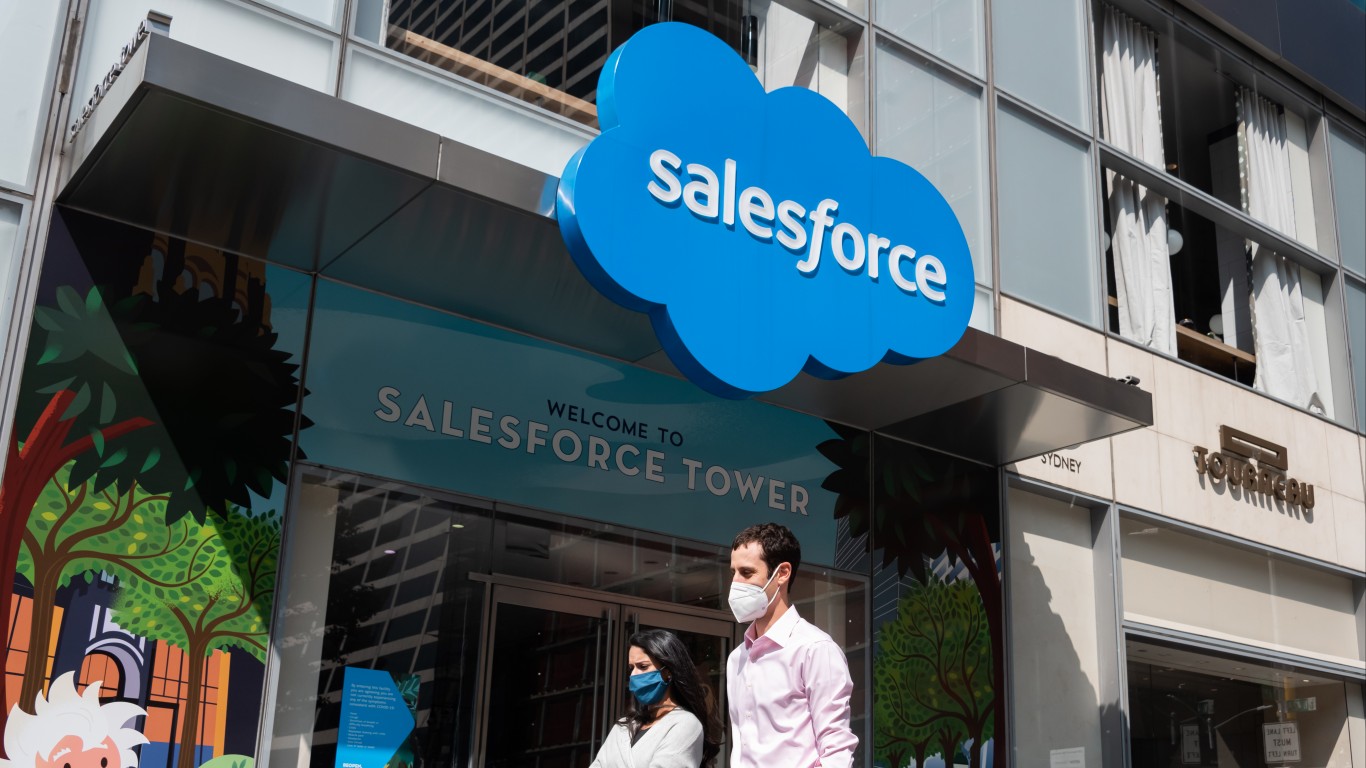
Salesforce has supplied investors with an operating target for 2030. The company aims to exceed $60 billion of annual revenue, excluding Informatica, and expects organic revenue to compound at more than 10% from fiscal 2026 through fiscal 2030. That target is more useful than a speculative $700 share-price forecast because it can be tested against reported results.
The second quarter of fiscal 2027 showed why the bull case exists. Revenue rose 11% to $11.3 billion. Remaining performance obligations reached $66.3 billion, while combined Agentforce and Data 360 annual recurring revenue approached $3.9 billion, up more than 210%. Agentforce alone exceeded $1.5 billion of annual recurring revenue.
The open question is whether AI agents add consumption revenue or reduce the number of paid software seats faster than Salesforce can replace them. The company is moving toward usage-based products, data services and premium editions, but those businesses must become large enough to protect growth in its established sales and service clouds.
Profit quality also matters. Salesforce reported a 20.5% GAAP operating margin and a 34.1% non-GAAP margin in the quarter. Strategic investment gains can make per-share earnings volatile, so cash flow and operating profit provide cleaner evidence of core progress.
A hypothetical $700 share price by 2030 would require more than revenue growth. It would depend on the share count, earnings per share and the valuation multiple investors are willing to pay at that time. Small changes in those assumptions produce very different outcomes.
The practical case is simpler. Salesforce needs to sustain double-digit organic growth, turn Agentforce adoption into recurring revenue and keep expanding margins without starving product development. If those pieces hold, the fiscal 2030 revenue target can support meaningful earnings growth. If AI weakens seat economics or Agentforce adoption stalls, a low forward multiple may reflect a real structural risk rather than an overlooked bargain.
Amazon's $496 Billion Backlog Turns Power Into the Constraint

Amazon Web Services ended the second quarter with $496 billion of contracted backlog, up from $364 billion three months earlier. That is powerful evidence of demand, but it also reveals the constraint on Amazon's largest growth opportunity: much of the business cannot become revenue until new data centers are powered and equipped.
AWS revenue rose 37% to $42.2 billion, its fastest growth in 18 quarters, while operating income reached $16.6 billion. Amazon said demand still exceeded available capacity and raised its 2026 capital-spending plan to about $220 billion, partly because of higher memory costs.
Backlog is not the same as cash in the bank. It represents contracted work to be delivered over time and can depend on Amazon making capacity available. Long contracts improve visibility, but they also lock in commercial terms while the cost of power, memory, accelerators and construction can move.
That tension explains why the opportunity is unusually large and unusually expensive. Amazon can use its balance sheet, custom Trainium chips and global infrastructure experience to build faster than smaller rivals. It can also spread fixed costs across a broad customer base. Yet the investment arrives before the revenue, which has pushed trailing free cash flow below its year-earlier level and increased the consequences of delays.
The most important investor question is therefore not whether customers want AI computing. The backlog already answers that. It is whether AWS can bring capacity online quickly enough and at returns that justify the spending.
Quarterly progress should be visible in four places: AWS growth, operating margin, backlog conversion and cash capital expenditure. If revenue and operating profit scale with the buildout, the $496 billion backlog is a durable advantage. If power bottlenecks or rising component costs slow delivery, the same backlog can expose how much capital Amazon must commit before customers can use what they ordered.
Latest comments