


 Be The Investor Research
Oklo and NuScale's Selloff Reflects Financing Risk, Not Just Rates

Oklo and NuScale each fell about 15% in a week as yields rose. Higher discount rates hurt, but project funding and commercialization remain the larger long-term risks.
Oklo and NuScale Power each fell about 15% in the week through October 19, according to the source article. The sharpest move followed a hot inflation report and a rise in the 10-year Treasury yield to 5.26%, which pressured long-duration growth stocks.
Advanced nuclear developers are especially sensitive to rates because much of their potential cash flow lies years ahead. A higher discount rate reduces the present value of those future earnings. It also raises the cost of financing development and construction.
Rates are only part of the story. The source estimates that analysts expect roughly $6.5 billion of additional cash use through 2030 across the relevant development plans, compared with Oklo's reported $3.0 billion of cash at June 30. That comparison is an analyst estimate, not company guidance, and it should not be treated as a precise funding requirement. It does show why capital availability matters.
The companies can reduce risk by converting customer interest into binding agreements, advancing licensing, securing fuel and presenting financeable construction schedules. Without those milestones, a lower share price alone does not make the stocks fundamentally cheap.
The next tests include third-quarter updates, regulatory progress and fuel arrangements. The selloff may be overdone if project milestones continue and financing remains available. It may be justified if timelines slip or equity issuance accelerates. Investors should analyze each company's cash runway and contracted projects separately rather than treating the nuclear theme as one trade.
Related News

Intel's 10% Slide Puts Its Packaging Strategy on Trial
Intel's selloff followed Lam Research's supply warning, but the harder company-specific test is whether Intel can convert constrained advanced-packaging capacity into profitable external foundry revenue.
Flutter's US Quarter May Meet Guidance as Promotions Ease
Jefferies now expects Flutter's US business to meet third-quarter guidance after promotional spending fell, but uneven state trends and the rapid growth of prediction markets keep the outlook unsettled.

EOG Leads ConocoPhillips on Current Cash Returns, but COP Has 2029 Upside
EOG offers stronger current margins, lower leverage and a clearer 2026 cash-return plan. ConocoPhillips asks investors to pay for a 2029 free-cash-flow lift from Willow and LNG projects.
Elbit Adds $200 Million of Asia-Pacific Airborne Contracts
Elbit Systems won about $200 million of airborne surveillance, training and display contracts in Asia-Pacific. The five-year execution period limits near-term revenue impact but broadens the company's regional backlog.

IonQ's $2 Billion Stock Sale Buys Time at a High Dilution Cost
IonQ paired an all-stock Elisity acquisition with a $2 billion equity financing. The cash extends its runway, but common shares, pre-funded warrants and long-dated warrants raise dilution risk.

Roku's $160 Fox Deal Leaves Little Upside and Real Regulatory Risk
Roku trades within 1% of Fox's $160 offer, leaving investors with a narrow merger spread and much larger downside if antitrust scrutiny delays or derails the $22 billion transaction.
Affirm Wins Sam's Club, but the Revenue Impact Is Still Unclear

Affirm has regained a meaningful place in Walmart's retail ecosystem through an exclusive, multi-year pay-over-time agreement with Sam's Club. The service is expected to reach online shoppers in the coming weeks and physical club locations in 2027. Eligible purchases will start at $500, according to the company's announcement.
The agreement matters because Walmart replaced Affirm with Klarna as its exclusive U.S. installment-payment provider in March 2025. The lost Walmart relationship represented about 5% of Affirm's gross merchandise volume and roughly 2% of adjusted operating income during the six months through December 2024, according to figures cited in the source report.
Sam's Club does not automatically replace that contribution. Affirm and Sam's Club did not disclose expected transaction volume, economics or minimum commitments. The rollout also begins online before reaching clubs, which may make the near-term financial effect modest. Exclusivity has strategic value, but investors cannot calculate the revenue contribution without more information.
The broader business enters the deal with strong growth. Affirm processed $50.2 billion of gross merchandise volume in fiscal 2026, up 37% from the previous year. Gross merchandise volume is the value of transactions facilitated on the platform, not Affirm's revenue. The distinction matters because revenue depends on merchant fees, interest income, loan sales and the credit and funding economics attached to those transactions.
Funding conditions remain a central risk. Affirm finances receivables through warehouse lines, securitizations, forward-flow agreements and loan sales. Higher benchmark rates can raise funding costs or reduce the price outside investors are willing to pay for loans. Credit losses can also widen quickly if household finances deteriorate.
Affirm is scheduled to report fiscal first-quarter results on November 5. The company guided to revenue of $1.19 billion to $1.22 billion and adjusted operating income of $137 million to $165 million, while consensus estimates cited in the source were near $1.21 billion and $154 million. Those figures provide a clearer near-term test than the Sam's Club announcement alone.
Investors should listen for three specifics: the pace of the Sam's Club rollout, any indication of transaction volume or merchant economics, and the cost of funding new loans. The deal improves Affirm's distribution and demonstrates that it can win a major exclusive account after losing Walmart. Its value to shareholders will depend on profitable volume, not the retailer's name by itself.
Oklo's Selloff Exposes the Price of Financing Nuclear Growth
The roughly 15% weekly declines in Oklo and NuScale were larger than the Nasdaq 100's 3.7% drop cited in the source, but the move was not simply a verdict on nuclear technology. It exposed how strongly pre-revenue and early-commercial-stage companies depend on the cost and availability of capital.
Oklo had about $3.01 billion of cash, cash equivalents and marketable debt securities at June 30. That balance is substantial relative to the company's near-term operating needs. Oklo expected 2026 cash used in operations of $120 million to $150 million and purchases of property and equipment of $400 million to $500 million.
The balance sheet, however, was built through significant equity issuance. Oklo raised about $1.85 billion through its at-the-market program in the first half of 2026. Shares outstanding rose to 185.1 million at June 30 from 160.5 million at the end of 2025, an increase of about 15.3%. On September 11, the company filed a new at-the-market program allowing sales of up to another $1 billion of common stock.
This does not mean Oklo will issue the full amount, and an at-the-market authorization is not an obligation. It does show that management wants continued access to equity while it develops projects that may take years to produce material revenue. Rising bond yields make future cash flows worth less today and can also make each new round of funding more expensive.
NuScale faces a related but different challenge. It has advanced its small modular reactor design and commercial discussions, but investors still need firm contracts, project financing and a credible construction timeline before projected revenue becomes bankable. Treating every nuclear developer as the same trade obscures differences in reactor design, licensing status, customer commitments and funding plans.
An analyst estimate cited in the source suggests Oklo may need another $6.5 billion of cash through 2030. That is not company guidance and should be treated as a scenario rather than a fact. The more defensible conclusion is narrower: current liquidity covers near-term plans, while the full buildout will probably require additional capital, partnerships or project-level financing.
The selloff may look excessive to investors focused on long-term demand for clean, reliable power. Yet valuation cannot be separated from financing. Oklo's selection for the Department of Energy's Groves 2 program provides strategic validation, but it does not eliminate development risk or dilution.
The next useful evidence will be project milestones, regulatory progress, customer commitments and the pace of equity issuance. If Oklo converts its cash balance into licensed, contracted projects, today's dilution may fund valuable growth. If timelines slip while the share count keeps rising, a lower stock price can make the next dollar of capital more costly.
Netflix’s Ad Forecast Cut Tests the Case for a Cheaper Stock

Netflix's third quarter was profitable, cash-generative and largely on plan. The reason the stock still looks unsettled is that the company's most important newer growth engine, advertising, is developing more slowly than management expected.
Revenue rose 11.8% from a year earlier to $12.874 billion, while operating income increased 37% to $4.459 billion. Operating margin expanded to 34.6% from 28.2%, and reported earnings reached $0.87 a share, up 49%. Netflix also generated $2.884 billion of free cash flow and spent $4.8 billion repurchasing 63.9 million shares, its largest buyback quarter.
The outlook revealed the tension. Netflix expects fourth-quarter revenue of $13.442 billion, up 11.5%, and an operating margin of 26%. The margin forecast includes about a 120-basis-point drag from recently announced headcount reductions. For all of 2026, management still expects $51.1 billion of revenue, 13% growth, and a 31.5% operating margin.
Advertising is the weaker point. Netflix cut its 2026 ad-revenue forecast to about $2.7 billion from roughly $3 billion, citing a slower rollout of some ad-product capabilities. Subscription revenue performed better than expected, and management said global and U.S. churn improved from a year earlier. That combination suggests the core subscription business remains healthy, but the ad platform needs more execution before it can justify the faster growth investors once priced into the shares.
Netflix also lowered expected 2026 free cash flow to about $12 billion from $12.5 billion, primarily because the closing of a real-estate transaction is now expected in the fourth quarter. That is a timing explanation, not evidence of weaker operating cash generation, but it still reduces the cash forecast for the year.
The original analysis placed the shares at 18.34 times next-12-month earnings after a 40.9% one-year decline. That valuation is far below the source's three-year mean of 33.30 times, yet a lower multiple is not automatically a bargain. The company guided to a fourth consecutive quarter of slower year-over-year revenue growth, and the source cited analyst estimates for only 5.6% normalized earnings growth in 2027. Those estimates are attributed, not company guidance.
The January results will carry unusual weight because Netflix plans to provide its 2027 outlook. A return to double-digit revenue growth with another margin increase would make the current multiple look more compelling. Single-digit growth would support the view that the stock has been repriced for a slower business.
The Warner Bros. episode explains part of the past year's volatility, but it is no longer the main question. Netflix walked away from the transaction and received a $2.8 billion termination fee. The valuation now turns on organic execution: advertising tools, engagement, pricing, content efficiency and the durability of cash flow.
Lula’s Re-Election Reprices Petrobras Dividend Risk

Petrobras shares fell 15% in early U.S. trading after Luiz Inácio Lula da Silva won Brazil's presidential runoff with 51.8% of the vote. The market reaction was not only about politics. It reflected a direct question about who controls Petrobras's cash.
Brazil's federal government is the company's controlling shareholder, so a fourth Lula term extends the administration's influence over board appointments, investment priorities and the balance between dividends and capital spending. The source reported that dividends consumed 94% of free cash flow in 2022 but less than 40% in 2024 and 2025 as capital investment increased. Those percentages came from the source's calculations and could not be independently reconciled line by line, so they should be treated as directional evidence rather than audited payout ratios.
Petrobras's own business plan shows the scale of the commitment ahead. The 2026-2030 plan calls for $109 billion of investment, including $91 billion in projects targeted for implementation and $18 billion under evaluation. Exploration and production accounts for $69.2 billion of the target portfolio. The company says the plan includes financing tests and quarterly reviews before some projects move forward, which provides a measure of discipline but does not remove the cash demand.
The same plan also carries strong operating economics. Petrobras estimates an average prospective Brent breakeven of $25 a barrel for its project portfolio and plans to lift oil production to a peak of 2.7 million barrels a day in 2028. That low-cost pre-salt base is the main counterweight to the policy risk. A company can invest heavily and still pay meaningful dividends if production grows and oil prices remain supportive.
The election selloff spread beyond Petrobras. The original report said MercadoLibre fell 12%, Ambev 12% and LATAM Airlines 9% in early trading. Those moves reflect currency and country-risk exposure, but Petrobras is different because the government directly controls it. That makes fuel pricing, taxes, project selection and dividend policy more immediate shareholder variables.
A lower earnings multiple does not settle whether the shares are cheap. The market is discounting uncertainty about how much free cash flow will remain after the new investment plan and whether ordinary or extraordinary distributions will absorb it. Petrobras has said capital discipline and financial sustainability remain central to the plan, yet investors will need cash-flow evidence rather than policy assurances.
The next useful test is the company's third-quarter report and any update to shareholder remuneration. Production, realized oil prices and operating cash flow will show how much room remains after investment. The election changed the probability assigned to competing uses of that cash; it did not erase the value of Petrobras's resource base.
Yum Has More Dividend Room, While McDonald’s Pays More Today
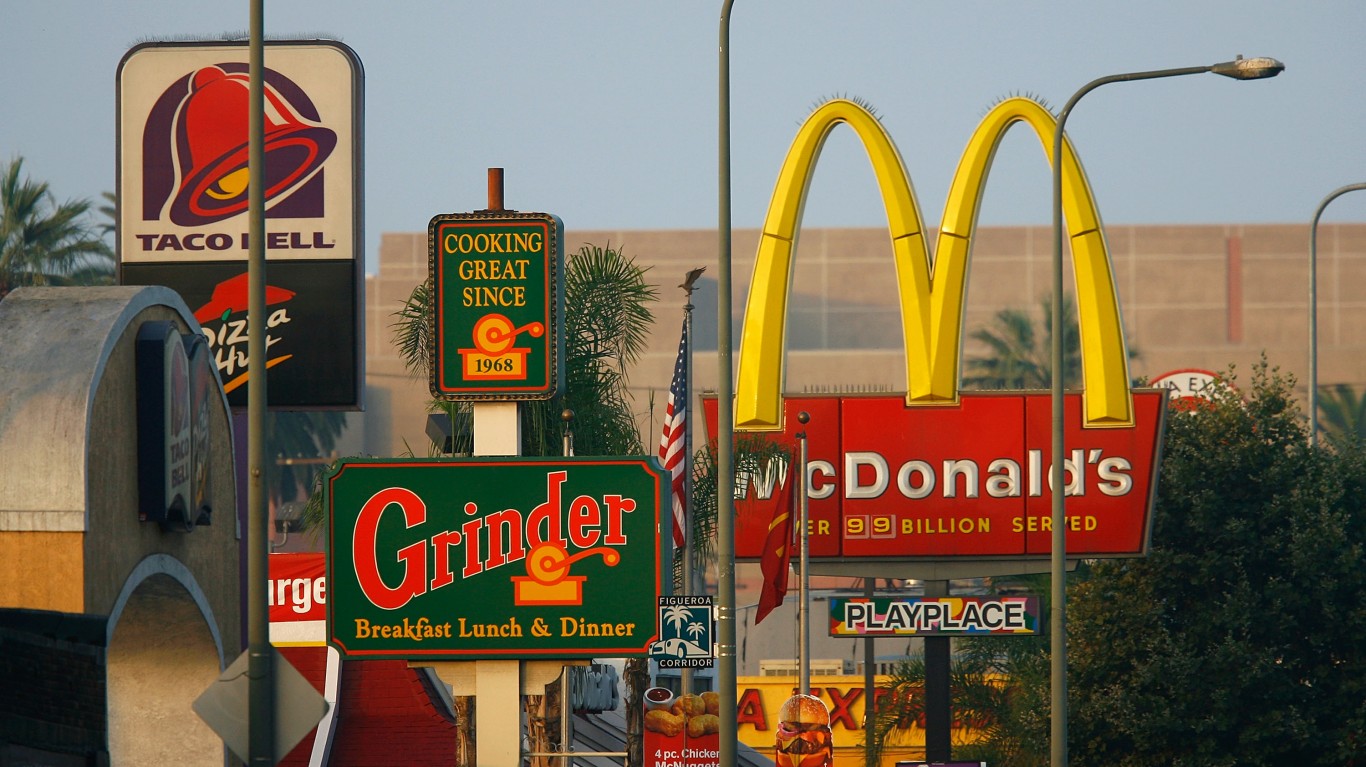
McDonald's and Yum Brands both run capital-light franchise systems, but their dividends occupy very different positions in the cash-flow stack.
McDonald's raised its quarterly dividend to $1.93, or $7.72 a year. Yum's quarterly dividend is $0.75, or $3.00 annually. At the prices used in the original comparison, those payouts implied yields of about 3.1% for McDonald's and 2.0% for Yum. McDonald's therefore provides the larger current income stream and has raised its dividend every year for much longer.
Yum has more room around its payout. Its 2025 filing shows $2.01 billion of operating cash flow and $371 million of capital spending, leaving $1.639 billion under a simple free-cash-flow calculation. Cash dividends of $789 million consumed about 48% of that amount. McDonald's reported $7.186 billion of free cash flow and paid $5.115 billion in dividends in 2025, a payout of about 71%.
Those percentages are BTI calculations from company filings. They are not identical to an accounting payout ratio based on net income, and they do not by themselves determine future dividend decisions. They do show that Yum entered 2026 with a larger cash-flow cushion relative to its dividend.
The operating picture is mixed. McDonald's global comparable sales grew 1.3% in the cited second quarter, down from 3.8% a year earlier, while management acknowledged uneven execution of recommended U.S. value pricing. Even so, the system produced more than $4 billion of restaurant-level margin, supporting the rent and royalty stream that funds corporate cash returns.
Yum's Taco Bell comparable sales rose 7%, restaurant margin reached 26.2% and KFC opened 660 gross units across 55 markets. A subsequent food-safety scare pushed Taco Bell's quarter-to-date U.S. comparable sales down 2%, showing how quickly brand-level momentum can reverse.
Yum also agreed to sell Pizza Hut in transactions valued at $2.7 billion. The company expects about $2.3 billion of net proceeds after taxes, adjustments and transaction-contingent fees, excluding an earn-out. Management said it expects to use proceeds for debt reduction and share repurchases, not a new dividend commitment. That matters because Yum operates with higher leverage and has said it intends to maintain net leverage around four times EBITDA.
The choice is therefore not simply yield versus growth. McDonald's offers more income now, backed by a longer record and a mature franchise cash engine. Yum has the lower cash-flow payout and stronger recent growth at Taco Bell, but the dividend must compete with debt reduction, buybacks and brand investment. For dividend growth, Yum has more mathematical room. Whether it uses that room depends on operating recovery and capital allocation after the Pizza Hut sale.
Latest comments