


 Be The Investor Research
Coherent's Rally Had Early Clues, but the Latest Quarter Raised the Bar
Coherent's revenue acceleration and margin improvement were visible before its stock surged. Fiscal 2026 ended with 34% quarterly growth, leaving capacity execution and cash generation as the next tests.
Coherent shares gained 135.4% in the 12 months through October 12, far ahead of the S&P 500's 17.3% return. The move looked sudden in the stock chart, but the operating improvement began appearing in filings well before the rally.
Revenue growth accelerated to 28% in the fiscal first quarter of 2025 from 9.1% in the prior quarter, while management pointed to a wider non-GAAP gross margin. Operating margin later reached 10.1%, compared with 5.9% in the quarter reported in August 2024. By August 2025, the company had also reduced its leverage ratio to 2.0 times from 2.5 times.
The evidence was not uniformly bullish. Revenue growth slowed to 23.9% and then 16.4% in the following reports, and operating margin eased to 9.5%. Investors who noticed the early turn still had to judge whether demand for optical components used in data centers would reaccelerate.
Coherent's official fiscal fourth-quarter 2026 results show that it did. Quarterly revenue reached $2.05 billion, up 34%, while GAAP gross margin was 38.5% and non-GAAP gross margin was 40.2%. Non-GAAP earnings were $1.74 per share. Management attributed the strength to data-center and communications demand and continued capacity expansion.
That newer evidence explains why the stock rerated, but it also raises expectations. A business priced for sustained AI infrastructure spending has less room for a capacity delay, customer digestion period or margin reversal. Revenue growth alone is not enough if capital spending absorbs the resulting cash.
The next useful evidence is whether Coherent can keep gross margin near current levels while converting its expansion into operating cash flow. The early clues were real, but the investment question has changed. Investors are no longer waiting for confirmation of demand; they are testing how much durable profit and cash that demand can produce.
Related News
Lockheed’s $292 Billion Backlog Raises the Cash-Flow Bar
Lockheed Martin’s record backlog and preliminary F-35 framework improve revenue visibility, but investors still need the company’s production commitments and $7 billion investment plan to translate into stronger free cash flow.

Archer's $1.6 Billion Cash Pile Buys Time, Not FAA Certainty
Archer has enough cash to fund its current burn for roughly two years on a simple run-rate basis. Certification timing and integration of Boeing's aviation assets remain the decisive uncertainties.
NRG's Target Cuts Put Data-Center Contracts in Focus
Analysts cut NRG price targets despite keeping Buy ratings. The sharper test is whether the company can convert its enlarged gas fleet and Texas development pipeline into signed data-center power contracts.

Oracle's Investor Day Must Turn 2030 Targets Into Milestones
Oracle's October 28 Investor Day must connect its $225 billion revenue goal and $21 adjusted EPS target to data-center timing, infrastructure margins and funding after Goldman Sachs cut its price target.

AstraZeneca's Sone-Ve Extends Survival but Misses a Key Endpoint
Sone-Ve extended median survival in advanced gastric cancer, but its independently reviewed progression-free-survival result missed statistical significance, leaving regulators to weigh a strong benefit against a split Phase 3 outcome.

Tradeweb and Centrus Deals Target Critical Business Links
Tradeweb's proposed $1.97 billion Trumid purchase and Centrus Energy's completed $116 million Westerman deal target control of critical infrastructure. Salesforce's planned Braze acquisition shows the same strategy in customer engagement, but integration remains the test.
Redwire's Drone Order Tests Its Ability to Scale

Redwire's $13.8 million order to supply Stalker uncrewed aircraft to the U.S. National Guard is modest beside the company's $542.1 million second-quarter backlog, but it supports a larger strategic claim: military drone demand increasingly rewards systems that can be updated as quickly as battlefield tactics change.
The order will place Group 2 Stalker aircraft at training sites including Camp Shelby in Mississippi and Fort Indiantown Gap in Pennsylvania. Redwire said National Guard instructors will use the systems to train soldiers in complex flight operations, field maintenance and multi-mission payload deployment. The curriculum supports the Army's new 15X Tactical UAS Specialist role, which combines operating and maintaining drones instead of separating those jobs.
That training role is important because it can put Redwire's hardware into the operating routines of future Army units. It does not guarantee a follow-on procurement program, however. The company described the awards as purchase orders worth approximately $13.8 million and did not disclose aircraft quantities, delivery timing or expected margins.
Redwire Co-President and Chief Growth Officer Josh Stinson framed adaptability as the product's core advantage in an NYSE interview cited by Stocktwits. He said the Stalker platform has evolved through many iterations since its first Defense Department delivery in 2006, including changes for extreme temperatures and contested environments. He also said Redwire has delivered more than 300 Penguin aircraft for use in Ukraine, where a tactic that worked weeks earlier may already be obsolete. That figure came from management and was not broken out by customer, contract value or period.
The financial context makes execution more important than the headline order. Redwire reported second-quarter revenue of $117.1 million, up 89.6% from a year earlier, and a record 27.8% gross margin. Contracted backlog reached $542.1 million, while adjusted EBITDA remained negative at $3.2 million and the reported net loss was $41.0 million. Management reaffirmed full-year revenue guidance of $450 million to $500 million.
At roughly 2.5% of the June backlog, the National Guard order is evidence of demand, not a company-changing award. Its greater value may be in standardization. If soldiers learn to operate and maintain Stalker systems during training, Redwire could be better positioned for later unit-level orders, payload upgrades and maintenance work. Investors still need evidence that those opportunities convert into funded contracts and positive operating profit.
Capacity is another part of the test. Stinson said Redwire is expanding its Huntsville, Alabama, facility from 68,000 to 164,000 square feet, alongside production sites in California, Michigan and Latvia. Additional floor space can support higher output, but it also raises the cost of carrying capacity if orders arrive more slowly than expected.
The near-term question is therefore not whether drone demand exists. Redwire's orders, backlog and Ukraine experience all support that case. The question is whether a company still reporting losses can turn rapid product iteration and a wider manufacturing footprint into repeatable deliveries, stronger margins and cash generation.
Walmart's 15% Rally Came From Multiple Expansion

Walmart's 15.4% October rally did not come with a higher near-term earnings estimate. From September 30 to October 23, the shares rose from $103.92 to $119.89 while the next-12-month normalized earnings estimate stayed at $3.00 a share. The forward price-to-earnings ratio therefore expanded from about 35 times to about 40 times. Investors paid more for the same forecast.
That distinction matters because Walmart's operating story is strong, but the stock now demands that strength continue. In its fiscal second quarter ended July 31, the company reported $187.9 billion of revenue, up 5.9% from a year earlier, while global e-commerce sales grew 23%. Adjusted earnings per share rose 19.1% to $0.81. Management raised full-year adjusted earnings guidance to $2.80 to $2.87, yet guided fiscal third-quarter adjusted earnings to $0.62 to $0.64, compared with $0.62 a year earlier.
Part of the quarterly strength came from tariff refunds that Walmart is reinvesting in lower prices. Chief Financial Officer John David Rainey told investors to evaluate the second and third quarters together because those refunds boosted the second quarter while the price investments weigh on the second half. The company also expects the timing of Flipkart's Big Billion Days to reduce third-quarter sales growth by more than one percentage point. Those timing effects make one quarter a poor test of the underlying trend.
The October rally also reflected confidence that Walmart can turn its stores, membership programs and marketplace into a broader commerce platform. On October 20, the company combined Walmart+ and Sam's Club Plus for $120 a year, almost $100 less than the two memberships previously cost separately. Walmart said the change should not materially affect its fiscal third-quarter or full-year guidance. The offer may deepen loyalty, but the near-term financial cost is already included in the outlook.
Marketplace growth provides a second route to higher returns. Walmart executive Manish Joneja said at a September investor conference that 40% of customers buying a cited Nespresso product through Walmart had not previously bought coffee from the retailer. That example suggests the marketplace can attract incremental customers rather than merely shift existing store purchases online. It is still one product example, not proof that the pattern applies across the catalog.
The valuation now leaves less room for a routine quarter. A TIKR scenario valued the shares near $153 by January 2031 using about $4.24 of fiscal 2031 GAAP earnings per share and a roughly 36-times multiple. That is a scenario, not a forecast, and it implies about a 6% annualized return from the October 23 price. If the forward multiple merely returned to the roughly 35-times level seen at the end of September while the $3.00 earnings estimate stayed unchanged, the same math would point to a price near $104.
Walmart reports fiscal third-quarter results on November 19. The important evidence will be whether comparable sales, e-commerce growth and membership gains support the higher valuation while management keeps the $2.80 to $2.87 annual earnings range intact. The October rally has already priced in confidence. The next report must show that operating performance, not another increase in the multiple, can carry the shares from here.
AT&T's Planned Headquarters Carries a $3.5 Billion Financing Test
Developer KDC is seeking about $3.5 billion in private debt for AT&T's planned headquarters campus in Plano, Texas, according to Bloomberg Law. The proposed financing is unusually large for a credit tenant lease transaction and would be backed by future rent from AT&T rather than by an operating history at the new property.
CGA Capital and CBRE are arranging the transaction, which is expected to have a weighted-average life of 18.7 years. Credit tenant lease financing uses a highly rated tenant's long-term rental obligation to support debt service. That structure can lower a developer's financing risk, but it still depends on final lease terms, construction execution and lender appetite.
The scale stands out. PGIM Real Estate has described typical credit tenant lease transactions as ranging from $25 million to $100 million. A $3.5 billion package would sit far outside that range and may need multiple investors, tranches or other structural protections. The comparison does not make the deal impossible, but it shows why financing itself is a central part of the story.
Plano's incentive agreement requires AT&T to support at least $1.35 billion of construction. KDC previously obtained a $400 million construction loan from JPMorgan in May. Public filings describe an 11-building campus on 54 acres, with estimated project costs above $1 billion, a planned December 1 construction start and completion in March 2029.
Those figures do not yet reconcile into a final capital stack. The reported $3.5 billion financing request is larger than the construction commitment and filing estimates, and the detailed use of proceeds has not been publicly disclosed. CGA declined to comment, while other parties did not provide a response to Bloomberg Law. Terms could change before any financing closes.
For AT&T investors, the project is strategically relevant but not yet an earnings catalyst. The company would gain a consolidated headquarters built around a long lease, while the developer and lenders bear much of the upfront financing task. The effect on AT&T's cash obligations depends on rent, guarantees, commencement dates and accounting treatment that have not been disclosed in the report.
The next meaningful evidence will be a closed financing package and final construction timetable. Until then, the proposed headquarters is a large, credible development plan with an unresolved funding structure, not a completed transaction.
GE Vernova's Selloff Tests the Financing Assumptions Behind AI Demand

GE Vernova fell nearly 12% on October 22, while Vertiv and Eaton also declined, after Meta's quarterly report forced investors to look past the scale of artificial-intelligence spending and ask how that buildout will be financed. The reaction hit companies that sell power-generation, grid and cooling equipment into the data-center boom.
Meta reported third-quarter revenue of $64.6 billion, up 26% from a year earlier, and capital expenditures of $34.9 billion. It also disclosed an $18.59 billion litigation agreement and a related $9.89 billion third-quarter charge. Separately, Meta announced a new class of non-voting stock. That corporate action does not prove an imminent financing need, but it added to a broader debate about how hyperscalers will fund a rapidly expanding infrastructure program.
The market's concern was not that data-center power demand had disappeared. GE Vernova ended the second quarter with a $176 billion backlog after orders rose 88% organically and revenue increased 22%. Those figures show substantial demand for generation and grid equipment well beyond a single customer or project.
The harder question is conversion. A backlog records contracted work, but revenue and cash arrive over time and depend on customer financing, permitting, supply availability and project schedules. If hyperscalers or their development partners delay projects, equipment suppliers can retain long-term demand while still experiencing near-term order timing or cash-flow volatility.
That distinction helps explain why GE Vernova's shares fell much more than the broader market even though the company had not issued a new warning. Investors had priced in years of strong electricity demand from AI facilities. Meta's spending profile reminded them that equipment demand is only as durable as the capital behind each project.
The selloff also should not be read as evidence that Meta cannot finance its plans. Meta remains a large, profitable company, and its revenue continued to grow. The defensible conclusion is narrower: investors raised the discount they apply to suppliers whose valuations depend on an unusually fast infrastructure cycle.
GE Vernova reports its own third-quarter results on October 28. Orders, backlog composition, customer deposits and cash conversion will matter more than another broad statement about AI demand. If those indicators remain strong, the October decline may prove to have been a financing-risk reset rather than a break in the underlying power-equipment cycle.
Dollar Stores Slide as Tariff Relief Clouds the Earnings Picture
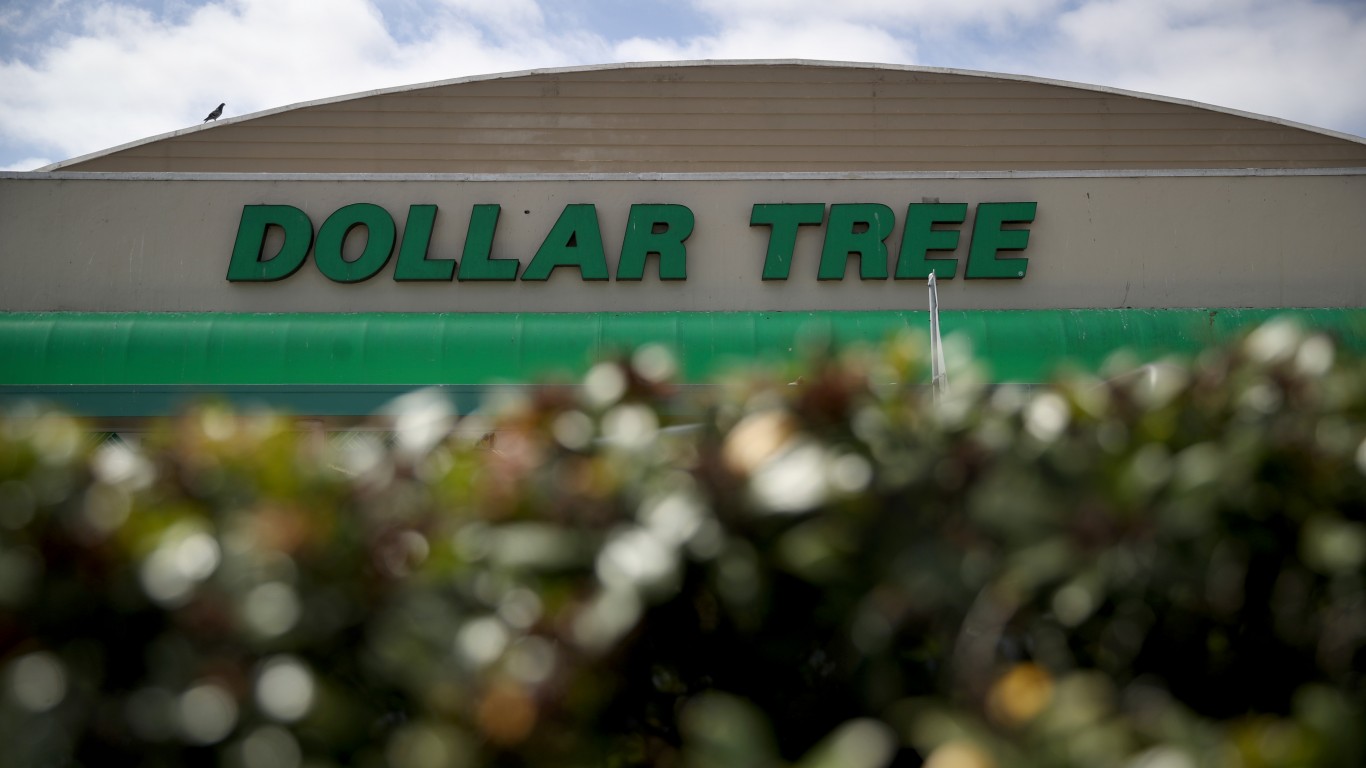
Dollar Tree and Dollar General each fell about 6% on October 23, a steeper decline than the roughly 2% drop in the SPDR S&P Retail ETF and the 0.4% decline in the S&P 500. Neither retailer issued a new earnings report that day, so the move looked less like a reaction to fresh company news and more like a reassessment of the discount-store trade.
The companies still serve a customer base under pressure, but their recent results require careful reading. Dollar Tree reported second-quarter fiscal 2026 earnings of $2.70 per share under generally accepted accounting principles. Management said $1.31 of that amount came from tariff refunds, a benefit that does not describe the underlying operating pace.
Dollar Tree's full-year adjusted earnings forecast of $7.70 to $8.05 per share includes about $0.60 per share of net benefit from those refunds. For the third quarter, management projected earnings of $0.80 to $0.95 per share and said reinvesting part of the tariff proceeds would reduce the quarter's earnings by roughly $0.50 per share. The same event therefore helps the full-year figure while making quarter-to-quarter comparisons harder to interpret.
Dollar General's latest reported quarter offered a different signal. Net sales rose 5.2% to $11.3 billion, and same-store sales increased 3.5%. Traffic contributed 2.0 percentage points and the average transaction added 1.5 points. Those figures show that shoppers continued to visit the chain, but they do not erase management's warning that its core customer remains financially strained.
The investment question is not simply whether consumers are trading down. Higher-income shoppers can provide incremental traffic, while financially stretched households may limit basket growth or shift toward lower-margin essentials. At the same time, tariffs can pressure merchandise costs and temporary refunds can obscure the earnings base.
The October 23 selloff did not establish a new deterioration in either business. It did, however, show how little patience investors have for results that depend on one-time benefits or an uncertain consumer backdrop. The next earnings releases should be judged on comparable sales, traffic, gross margin and inventory, with tariff refunds separated from recurring profit.
A durable recovery would require both chains to convert traffic into profitable sales after the temporary tariff effects fade. Until that evidence arrives, the sharp one-day decline is better understood as a risk repricing than as proof of a new company-specific setback.
Latest comments