



 Be The Investor Research
AbbVie’s Dividend Still Has Cover, but Apogee Adds Leverage
AbbVie raised its quarterly dividend 5.5% as Skyrizi and Rinvoq offset Humira’s decline. The $10.9 billion Apogee acquisition strengthens the pipeline but adds debt and near-term dilution.
AbbVie’s dividend is growing faster than many large pharmaceutical payouts, but investors are receiving a lower yield after a strong share-price run. The company now pays $1.73 per share each quarter, up from $1.64 in 2025. That 5.5% increase lifts the annualized payout to $6.92.
At a share price of $285.40 cited in the source article, the forward yield was about 2.4%. The yield fell because the stock had gained 28.6% for the year, not because the dividend was cut. For an income investor, that distinction matters: the cash payment increased, while the price paid for each dollar of income rose.
Coverage remains reasonable on management’s adjusted figures. AbbVie guided to 2026 adjusted earnings of $13.87 to $14.07 per share. Using the midpoint, the annual dividend consumes about 49.5% of adjusted earnings. Free cash flow also exceeded the cash needed for the payout in the source analysis. GAAP earnings are less useful for this comparison because acquired research and development charges can make the trailing price-to-earnings ratio look unusually high.
The operating support comes from Skyrizi and Rinvoq. In the second quarter, Humira revenue fell 35.9% to $756 million, while Skyrizi rose 24.4% to $5.51 billion and Rinvoq increased 24.5% to $2.53 billion. Together, the two newer immunology drugs generated about $8.03 billion. Imbruvica remained a weak point, with revenue down 29.4%.
AbbVie’s agreement to acquire Apogee Therapeutics for about $10.9 billion could deepen the immunology pipeline, but it changes the balance-sheet calculation. The company expects the transaction to reduce 2026 adjusted earnings by $0.14 per share and plans to finance it with cash and debt. AbbVie already carried net debt of roughly 2.26 times EBITDA in the source analysis.
The dividend is not under immediate pressure based on current adjusted earnings and cash flow. The next test is whether Skyrizi and Rinvoq keep replacing Humira’s lost sales while management absorbs Apogee without allowing leverage or development spending to crowd out future increases.
Continue your APGE research
Related News

Bank OZK's Rising Dividend Is Well Covered, but Credit Still Sets the Limit
Bank OZK raised its quarterly dividend for a 65th straight quarter. A payout near one-third of earnings provides room, while construction-loan credit remains the main constraint.
Moderna's Melanoma Data Must Justify a Rally Analysts Do Not
Moderna rallied ahead of full Phase 3 melanoma data due Oct. 24, even as Goldman Sachs kept a Neutral rating and set a target well below the share price.

Novavax's Selloff Puts the Sanofi Partnership Under the Microscope
Novavax fell harder than the broader biotech market as investors reconsidered a partner-led business. Sanofi gives the company reach, but royalty and milestone timing remain outside Novavax's control.

Parabilis Heads Into ESMO With Strong Early Data and a High Bar
Parabilis will present updated zolucatetide data in desmoid tumors on Oct. 24. Early responses were strong, but investors still need durability, safety and a credible Phase 3 dose.
Pfizer's 5.8% Yield Depends on Cash Flow Catching Up
Pfizer's dividend remains covered by adjusted earnings, but 2025 free cash flow fell short of distributions. Debt and patent expirations leave management less room to restore dividend growth.
Three Stocks Hit New Lows, but the Risks Were Very Different
EyePoint, CoreWeave and Eos Energy touched new lows on the same day. The selloffs reflected three distinct problems: a failed pivotal trial, financing pressure and manufacturing execution risk.
Visa’s Valuation Depends More on Margin Expansion Than Sales Growth

Visa's October 16 closing price valued the company at 30.9 times the adjusted trailing earnings measure used by Trefis. Consensus estimates cited in that analysis reduce the multiple to 25.7 times fiscal 2027 earnings and 22.4 times fiscal 2028 earnings.
A falling forward multiple can look reassuring, but it only happens if the forecast profit arrives. The sales assumptions are not the hardest part. Consensus calls for revenue growth of 10.7% in fiscal 2027 and 10.4% in fiscal 2028, below the 14.4% growth reported for the 12 months through June 2026 in the source analysis.
The margin is the real assumption
Consensus expects fiscal 2028 net income to grow 14.7% while revenue grows 10.4%. It also models a 60.2% net margin in fiscal 2028, up from an estimated 56.6% in fiscal 2026. That 3.6 percentage-point expansion requires costs to rise more slowly than revenue over two years.
Management's fiscal fourth-quarter outlook, as cited by Trefis, gave only modest support for that gap. Visa guided net revenue to the high end of low-double-digit growth and operating expenses to low-double-digit growth. The company also discussed job reductions, but cost action must be large and durable enough to improve margins without weakening product investment.
Recent revenue included some items that may not repeat at the same pace. Management cited tax refunds, fuel spending, FIFA-related activity and Visa Direct in U.S. payment volume. Pismo and Newpay added a little under 1.5 percentage points to fiscal third-quarter revenue growth on the non-GAAP basis described in the original analysis.
The valuation therefore has two layers of risk. Payment volume and services must sustain roughly double-digit revenue growth, and expense growth must remain lower for consensus margin expansion to appear. A miss on either can keep the forward multiple from compressing as expected.
The next report should be read as a margin bridge, not only an earnings comparison. Revenue growth, incentives, personnel costs and acquisition contributions need to explain how Visa gets from current profitability to the consensus 2028 margin. Until then, the 22.4-times fiscal 2028 figure is a scenario, not an observed price.
Applied Digital’s Growth Story Now Hinges on Cash-Flow Timing

Applied Digital's 10% rebound followed a difficult stretch for AI-infrastructure stocks, but its investment case is increasingly about balance-sheet timing. The company is building large data-center campuses under long leases, which can create durable revenue only after construction milestones are met.
The scale is already visible. Applied Digital reported fiscal 2026 cash capital spending of roughly $2.87 billion and operating cash flow of about $89.7 million in the original analysis. At May 31, the company's earnings release listed $4.2 billion of cash, cash equivalents and restricted cash, compared with $5.0 billion of debt.
Those totals need careful interpretation. Restricted cash is often committed to construction accounts, debt service or letters of credit. It cannot be treated as fully interchangeable with unrestricted cash. Debt can also sit at project subsidiaries with different security and repayment terms, so a simple net-debt subtraction misses the timing of inflows and obligations.
Leases create visibility, not instant cash
Applied Digital has described 1.41 gigawatts of leased capacity and about $36 billion of initial contracted revenue in the source report. Those figures represent long-duration commitments rather than one year's sales. The economic value depends on delivering each building, collecting rent and financing tenant fit-out costs without excessive leakage to interest or new equity.
The company's fiscal first-quarter figures in the source showed revenue rising 322% and included $183.5 million of tenant fit-out revenue. Fit-out revenue can be substantial, but investors should separate it from recurring base rent because the margin, timing and capital requirements differ.
A useful cash-flow bridge starts with unrestricted cash, adds committed project funding and tenant contributions, then subtracts remaining construction, interest and corporate overhead. Management's disclosure of interest expense and lease-related revenue should make that bridge easier to test over successive quarters.
The next report should show delivered capacity, recurring lease revenue and remaining cost to complete by campus. If those numbers improve together, the backlog is becoming an operating business. If debt and restricted cash rise faster than energized capacity, the stock remains dependent on favorable capital markets.
A Roth IRA Is Not Automatically the Best Home for Every High-Yield Stock
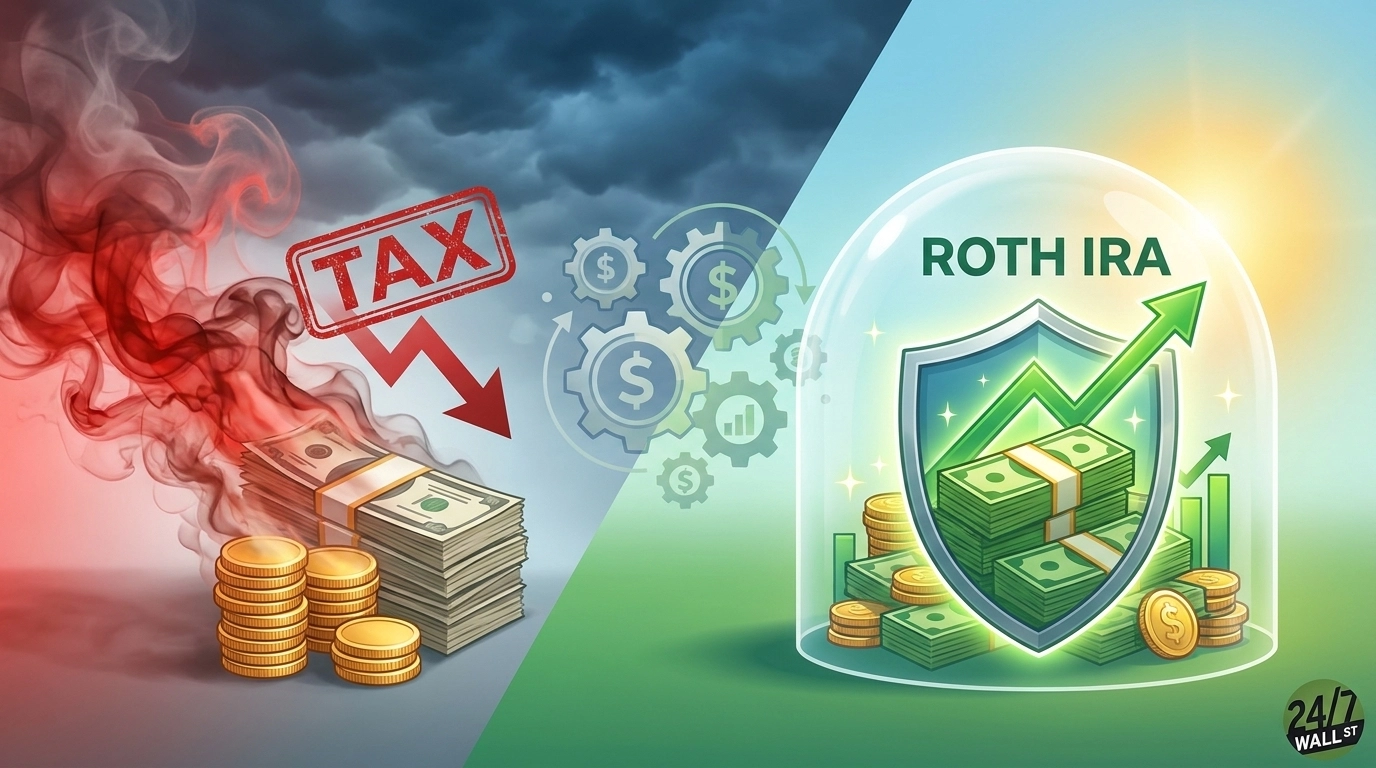
A Roth IRA can shelter years of dividends and capital gains from current tax, and qualified withdrawals are generally tax-free. That makes it attractive for investments with high expected returns. It does not mean every high-yield stock belongs there.
The original portfolio example mixed Energy Transfer, Realty Income, Main Street Capital, Ares Capital and Verizon. Those securities do not produce the same type of income. Verizon dividends are generally eligible for qualified-dividend treatment when holding-period rules are met. REIT and business-development-company distributions can include ordinary income, capital gains and return of capital. Energy Transfer is a master limited partnership that typically issues a Schedule K-1.
The MLP complication
Partnership investments can generate unrelated business taxable income, or UBTI, inside an IRA. IRS instructions say an IRA may need its own Form 990-T when gross unrelated business income reaches $1,000 or more. That does not make every MLP unsuitable for a Roth, but it means the custodian, tax reporting and position size matter.
The simplified claim that all dividends in a taxable account face one ordinary-income rate is also wrong. The tax result depends on the distribution's character, the investor's bracket, holding period and state. Return of capital may reduce cost basis instead of creating immediate income, while qualified dividends may receive preferential federal rates.
Account space has an opportunity cost. The 2026 IRA contribution limit is $7,500, or $8,600 for people age 50 or older, before income-based Roth restrictions. Filling that limited space with a slow-growing yield stock can crowd out assets with higher expected long-term gains. A taxable account also provides easier access and can allow tax-loss harvesting.
The better decision is made at the portfolio level. Compare each holding's expected return, tax character, turnover and liquidity needs, then place the least tax-efficient assets in protected accounts when practical. MLPs deserve an additional UBTI and K-1 check before purchase.
Roth treatment can improve after-tax compounding, but tax savings do not rescue a weak security. Yield, balance-sheet risk and dividend durability still come first, and individual tax circumstances can justify professional advice.
Albertsons Seeks More Than $8 Billion From Kroger After Failed Deal

Albertsons is asking a Delaware court for more than $8 billion from Kroger after their $24.6 billion merger collapsed under regulatory pressure. The figure is a claim, not an award, and the trial that began October 19 will determine whether Kroger breached the companies' agreement and caused the alleged losses.
The dispute turns on which side bears responsibility for the failed antitrust remedy. Albertsons argues Kroger did not use the required efforts to obtain approval and pursued a divestiture plan that regulators and courts found inadequate. Kroger says it complied with the merger agreement, worked extensively with regulators and owes neither the $600 million termination fee nor the broader damages.
How the claim reaches $8 billion
The reported demand combines several categories. Albertsons seeks the $600 million termination fee, about $6.88 billion tied to the premium its shareholders would have received, and more than $1 billion of alleged tax and other adjustments. Those components should not be added to market value as though payment were certain. The court must decide whether each item is recoverable, supported and caused by Kroger's conduct.
Kroger's own filings describe counterclaims, including alleged damage to its business and reputation. Its May and August 2026 quarterly reports also confirm that the Delaware trial was scheduled for October 19. Albertsons' filings say the companies terminated the deal after federal and state courts blocked it in December 2024.
The legal exposure is asymmetric in a practical sense. Albertsons could receive a large payment if it proves its case, while Kroger could face cash costs and financing consequences. A defense win would remove that overhang but would not restore the merger or the operating plans built around it.
Investors should separate three questions: whether Kroger breached the contract, whether Albertsons can prove the claimed losses, and how much the court considers recoverable. A ruling on liability may not immediately settle the amount if damages require a separate analysis.
The most useful developments will be trial evidence about the divestiture strategy, the exact wording of the efforts covenant and the judge's treatment of the lost-premium theory. Until then, the $8 billion figure measures the size of Albertsons' demand, not the probability-weighted outcome.
Three Record Highs, Three Very Different Investor Signals

A 52-week high tells investors that a stock has momentum. It does not explain whether that momentum rests on a fresh business improvement, a durable structural change or simply a richer valuation. Exxon Mobil, Visa and Atlassian illustrated all three possibilities when their shares touched annual highs in the same week.
Exxon offered the clearest near-term earnings catalyst. In a regulatory update ahead of results, the company estimated that stronger energy-products margins could add about $4.5 billion to quarterly profit compared with the prior period. That estimate is directional rather than a full earnings forecast because it excludes other moving parts such as production volumes, chemicals, expenses and taxes. Even so, it shows why refining economics can move Exxon's earnings quickly when product margins widen.
Visa's catalyst was less cyclical. On October 15, the company said Visa Direct had launched stablecoin-powered prefunding for selected cross-border money movement with Inyo. Prefunding means a participant places money in advance so payments can settle when needed. Visa says the stablecoin structure can reduce the amount of cash that partners must keep parked across markets while preserving the familiar card-network interface. The commercial significance will depend on adoption, transaction volume and regulatory treatment, none of which the announcement quantified.
Atlassian's move reflected expectations rather than a single disclosed contract. Investors have focused on the software company's shift toward cloud subscriptions and on whether artificial intelligence features can deepen customer use. Those themes can support recurring revenue, but they also raise execution questions about migration costs, competition and the pace at which new products convert into paid demand. The shares reached an annual high before reversing lower, a useful reminder that enthusiasm can be fragile when valuation already assumes strong delivery.
The three highs therefore deserve different readings. Exxon's evidence points to a measurable but cyclical margin benefit. Visa is testing a potentially more efficient settlement model whose economics remain undisclosed. Atlassian is being valued on longer-dated execution. A shared chart pattern does not create a shared investment case.
Latest comments