



Merck pays a higher yield, but Gilead has more cash behind it
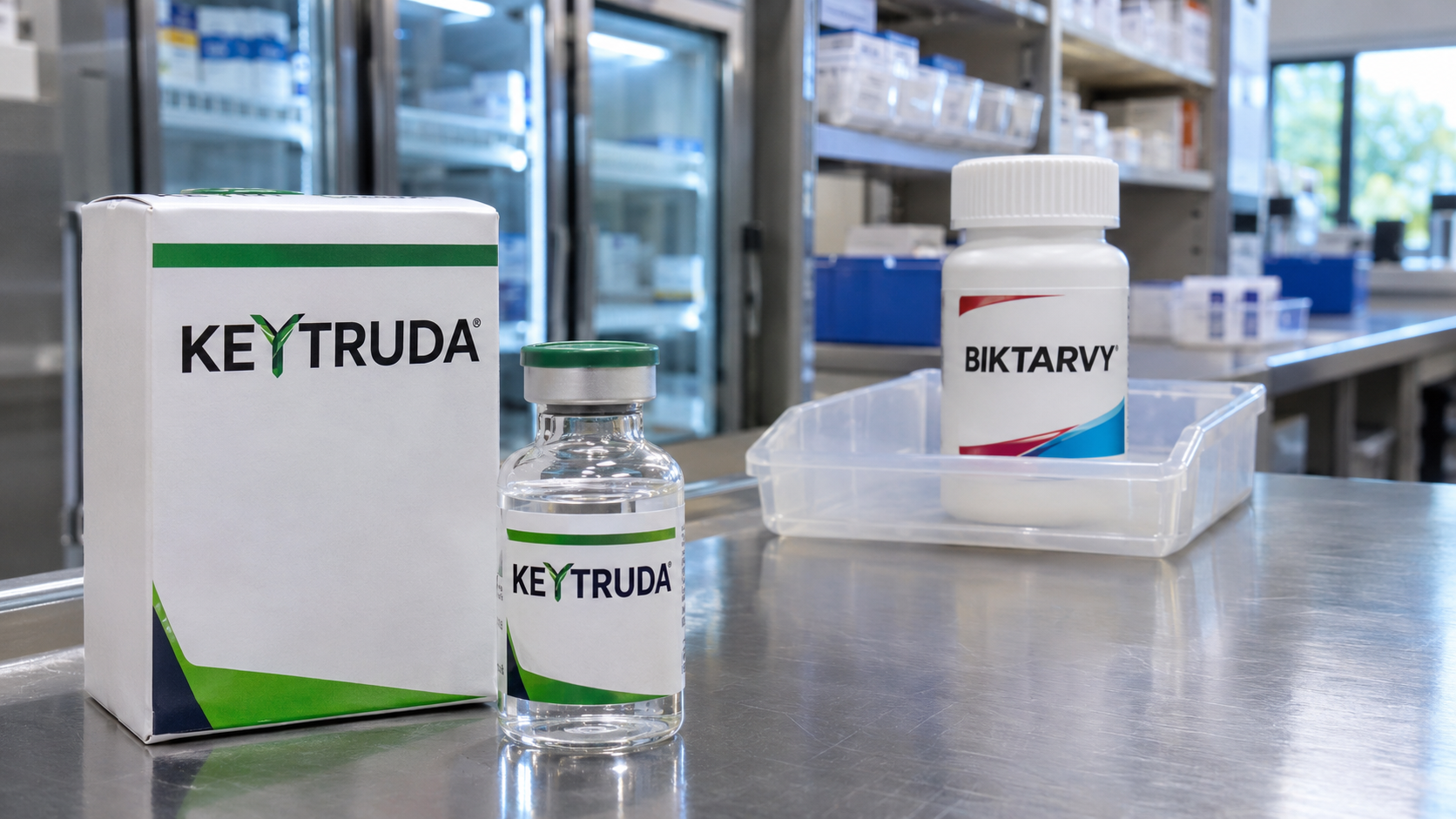
Merck’s dividend took 66% of trailing free cash flow, versus 30% at Gilead. The drugmakers face different threats to that coverage as Keytruda loses exclusivity and Medicare pricing changes for Biktarvy.
Merck offered a 2.3% dividend yield in TIKR’s November comparison, ahead of Gilead Sciences at 1.8%. The difference reverses when the measure is cash coverage. Merck’s dividends used about 66% of free cash flow over the 12 months through September 30, versus 30% at Gilead, according to TIKR. Those ratios show how much cash the companies paid out, not what their boards will declare next.
Merck’s third-quarter sales rose 5% to $18.1 billion. Keytruda accounted for about $8.6 billion, close to half of the total. Sales of Winrevair, Merck’s treatment for pulmonary arterial hypertension, rose 93% to $694 million, a meaningful increase but far smaller than Keytruda’s sales base. Merck raised the lower end of its 2026 sales outlook to $66.8 billion and kept the top at $67.3 billion. As Keytruda loses exclusivity, growth from other medicines has to replace a much larger stream of revenue.
Gilead’s third-quarter product sales rose 13% to $8.3 billion. HIV sales rose 18%, and Biktarvy alone generated $4.1 billion. Gilead raised its 2026 product sales guidance to $31.0 billion to $31.3 billion from $30.1 billion to $30.4 billion. Management expects the negotiated Medicare price to contribute to an approximately $1.5 billion net impact on Biktarvy revenue in 2028 compared with 2027. That is a company estimate for one product, not a $1.5 billion cut to free cash flow. Gilead still expects total product sales and earnings per share to grow in 2028, based on assumptions that could change.
From fiscal 2020 to 2025, Merck’s annual payout rose from $2.48 to $3.28 per share, about 5.8% a year. Gilead’s grew from $2.72 to $3.16, about 3.0% a year. Gilead declared $0.82 per share for the December payment. Merck’s free cash flow did not cover its dividend in 2017 and 2020, according to TIKR, even though coverage was stronger from 2021 onward. Gilead’s free cash flow fell from $16.3 billion in fiscal 2016 to $9.46 billion in fiscal 2025, but it still covered the dividend each year in the comparison.
Merck starts with a higher yield and a faster recent pace of dividend growth. Extending both companies’ past growth rates would keep Merck ahead in cash paid on equal investments, but it assumes the part investors most need to test: whether each business can sustain those increases after its largest drug faces a new constraint.
Continue your GILD research
Image references: · מקור ייחוס · מקור ייחוס · מקור ייחוס · מקור ייחוס · מקור ייחוס · מקור ייחוס
Frequently asked questions
What is "Merck pays a higher yield, but Gilead has more cash behind it" about?
Merck pays a higher dividend yield. Gilead has more cash behind its payout, but a Medicare price change will test Biktarvy revenue.
Which stocks and assets does this article cover?
This article relates to GILD.
What is the market context?
Merck offered a 2.3% dividend yield in TIKR’s November comparison, ahead of Gilead Sciences at 1.8%. The difference reverses when the measure is cash coverage. Merck’s dividends used about 66% of free cash flow over the 12 months through September 30, versus 30% at Gilead, according to TIKR. Those ratios show how much cash the companies paid out, not what their boards will declare next. Merck’s…
When was this article published?
It was published on 13 / 11 / 2026 by Be The Investor Research.