



Forget VUG. Vanguard’s Value Fund Is Beating Its Growth Twin by 11 Points This Year, With None of the Magnificent Seven
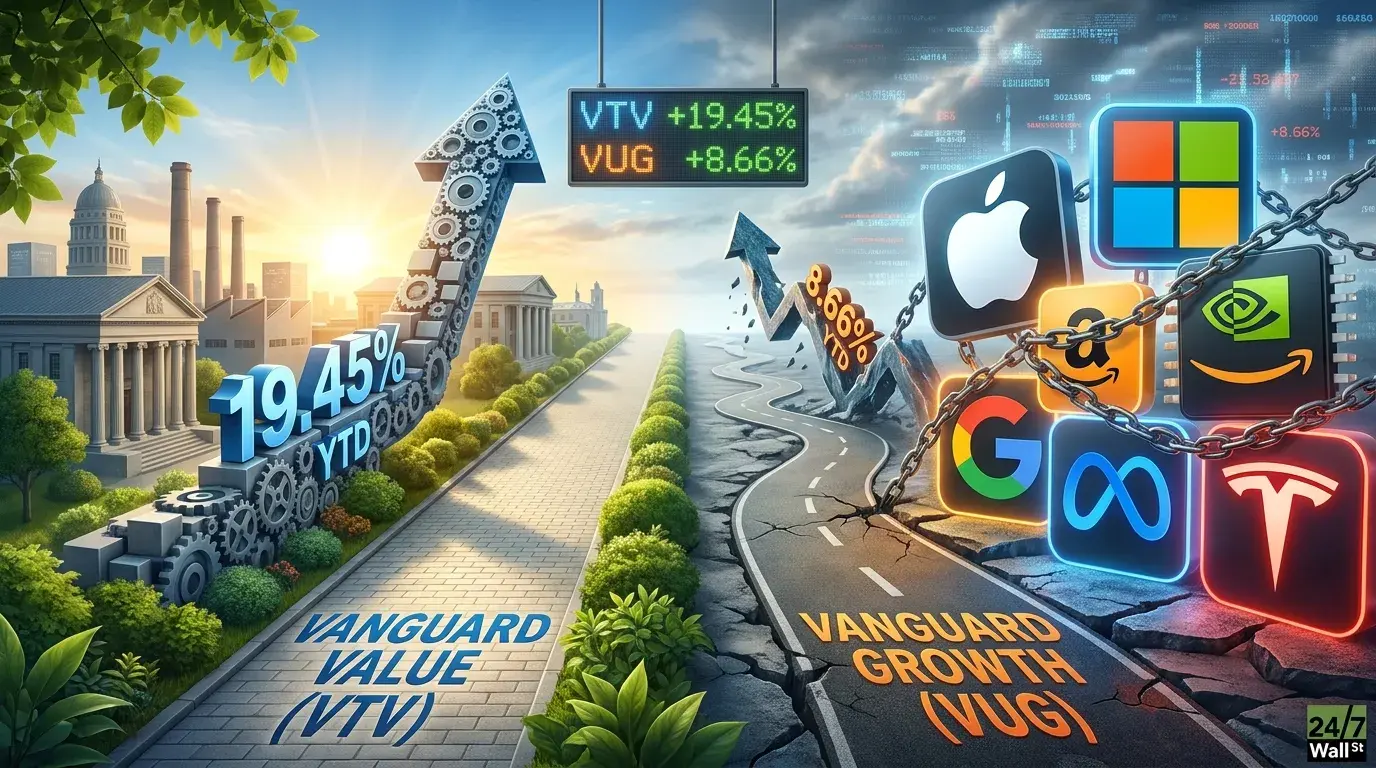
Vanguard Value ETF has sharply outperformed Vanguard Growth ETF in 2026 despite identical 0.03% fees, underscoring concentration risk, diversification benefits, income differences and tax considerations for large-cap investors.
The Vanguard Growth ETF (NYSEARCA:VUG) has gained 8.66% year to date through premarket trading on September 9, 2026, trailing the S&P 500’s 12.34%. Its Vanguard counterpart, the Vanguard Value ETF (NYSEARCA:VTV), has risen 19.45%, creating roughly an 11-point gap. Both funds come from the same issuer, draw from Vanguard’s split of the U.S. large-cap universe and list an identical 0.03% expense ratio. Their different results therefore reflect composition rather than fees. VTV owns none of the Magnificent Seven: Apple, Microsoft, Nvidia, Amazon, Alphabet, Meta or Tesla. VUG holds all seven. Its four largest positions are NVIDIA at 13.3%, Apple at 12.3%, Alphabet at 9.9% and Microsoft at 9.1%, with Amazon, Meta and Tesla also included. That distinction matters for investors holding an S&P 500 fund, total-market fund or SPY. The same seven companies anchor the S&P 500, so combining those holdings with VUG can multiply exposure to stocks already owned elsewhere. VTV offers large-cap U.S. exposure from a different roster. The advantage extends beyond 2026. Over the trailing year, VTV gained 26.42% versus VUG’s 14.09%. Over five years, VTV returned 82.15%, compared with VUG’s 76.92%. Value has regained competitiveness after lagging during the late 2010s, although growth remains viable. VTV may suit investors at or near retirement who have become unintentionally concentrated through a target-date fund, S&P 500 fund and VUG. A partial or complete rotation can reduce that concentration without abandoning large-cap equities. VTV also paid $4.09 per share in trailing 12-month distributions, versus VUG’s $1.58. Risks remain. Value can lag for extended periods, as during the 2020-to-2023 growth run. If AI capex continues compounding and Nvidia and peers capture more S&P earnings, VUG could lead again. Taxable investors selling appreciated VUG shares may trigger capital gains; directing new contributions to VTV or rotating partially may help. Inside an IRA or 401(k), switching is frictionless.