


 Be The Investor Research
DraftKings' Predictions Bill Divides Wall Street on Payback
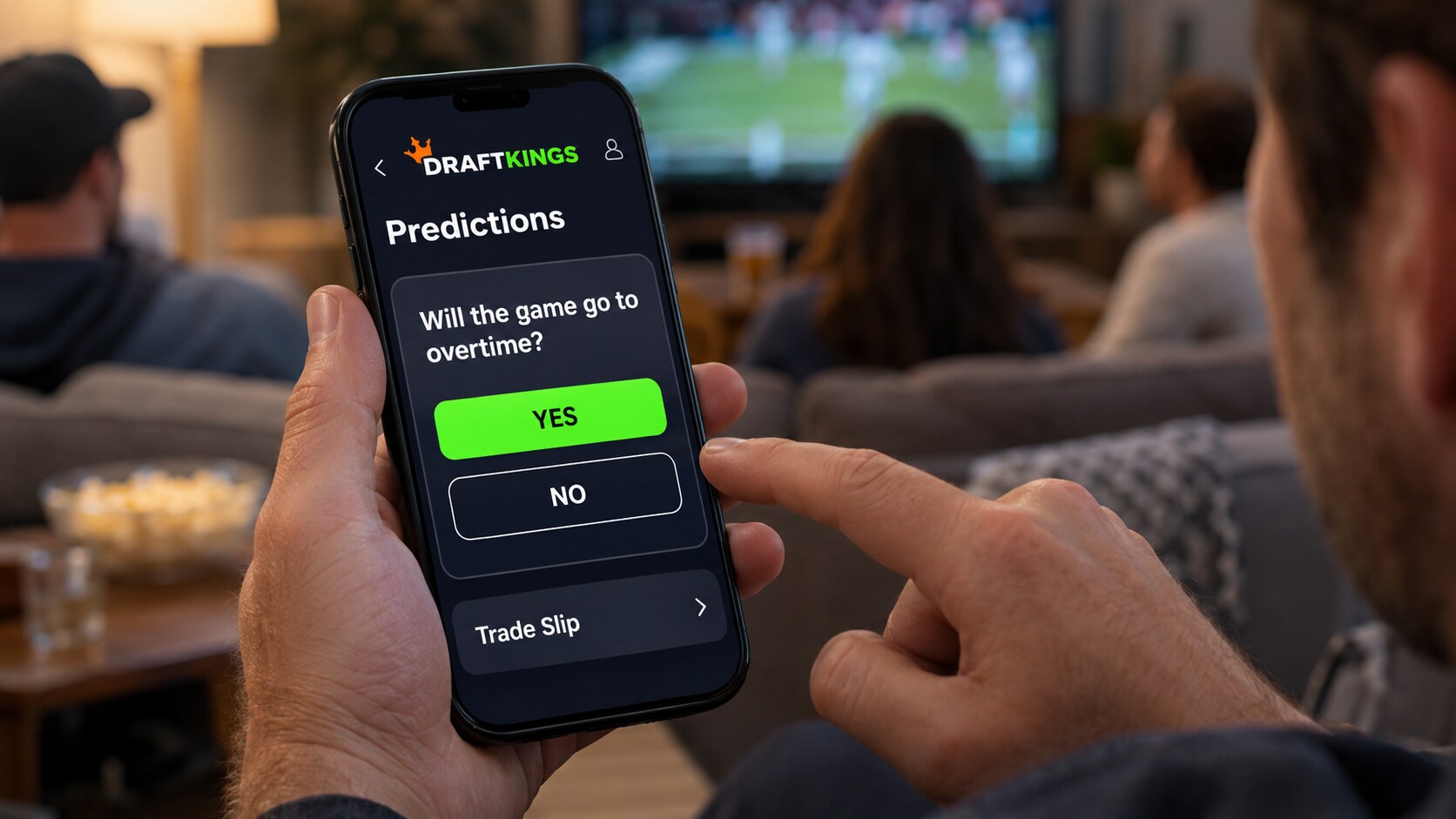
DraftKings cut its profit outlook after more than doubling its planned Predictions investment. Analysts disagree on the stock, but the bigger test is whether customers generate enough profit before competition or a ruling on sports contracts changes the economics.
DraftKings is spending as much as $700 million on Predictions this year, more than twice what it previously planned. What investors get for that money depends on how long the customers it recruits keep trading, and how much of their activity survives if courts restrict sports contracts.
The company reported $1.33 billion of third-quarter revenue, up 16% from a year earlier but below the $1.38 billion consensus cited by Stocktwits. Its adjusted EBITDA loss widened to $316.9 million from $126.5 million, while the reported operating loss reached about $493 million from $272 million. DraftKings lost $0.94 per share on a reported basis. It cut 2026 revenue guidance to $6.35 billion to $6.55 billion from $6.5 billion to $6.9 billion and adjusted EBITDA guidance to $175 million to $275 million from $700 million to $900 million.
Predictions accounts for most of the reset. DraftKings now expects $650 million to $700 million of 2026 investment measured against adjusted EBITDA, up from $200 million to $300 million, with $175 million to $225 million in the fourth quarter alone. The established business also weakened against plan: management lowered its estimate for 2026 core adjusted EBITDA from about $1 billion to $875 million to $925 million. It attributed about 60% of that reduction to sports results that favored customers and the rest to spending to acquire online casino players.
The exchange is not just a copy of the sportsbook. DraftKings earns brokerage, exchange and market-making revenue when customers trade event contracts. Its shareholder letter said more than 1.6 million customers had used Predictions in 2026 and that it kept about two-thirds of the gross revenue associated with the roughly 11.1% aggregate take rate it observed on DKeX trades in September and October. Third-party market makers captured the rest. Promotions are expected to offset most of the product's revenue this year, so neither trading volume nor that take rate is a measure of current profit.
Management estimates it can recover the cost of acquiring its 2026 customers in about 20 months and still recover that investment before July 2028 even if sports contracts end then. July 2028 is a scenario, not a scheduled ruling. Industry publication SBC Americas reported that the downside model for 2027 customers assumes only 20% of today's gross profit per customer remains after sports contracts end. Under that assumption payback lengthens from 18 to 41 months. The calculation depends on customers using non-sports contracts and other DraftKings products rather than leaving altogether.
Management expects 2027 core adjusted EBITDA of $1.15 billion to $1.25 billion, compared with $800 million to $1 billion for the whole company. It forecasts $650 million to $750 million of Predictions revenue and investment of $250 million to $350 million. The $900 million consolidated midpoint is about 20% below the $1.12 billion pre-report consensus cited by TIKR. Cutting spending may be difficult while FanDuel, Robinhood and specialist exchanges compete for traders. TIKR reported that Flutter's U.S. adjusted EBITDA fell to $3 million in the quarter and Robinhood's event-contract revenue reached $173 million; those figures measure different things, but both illustrate how quickly the market is changing.
After the shares dropped roughly 21% on November 6, JPMorgan, UBS and Stifel downgraded DraftKings. Wells Fargo and Berenberg followed on November 10, setting targets of $21 and $20. Guggenheim and Truist lowered targets to $28 and $22 but kept buy ratings, according to Stocktwits. Mizuho kept its outperform rating while cutting its target from $45 to $35. That was about 87% above the November 9 close of $18.70; TIKR estimated that reaching it on unchanged earnings expectations would require about 31 times forward earnings. It is an analyst scenario, not a return an investor can assume.
The company generated $63 million of operating cash in the first nine months, against about $169 million spent on equipment and software. It bought back no shares under its program in the third quarter after spending $154 million in the first half. Finance chief Alan Ellingson separately bought 18,908 shares for about $350,000 on November 9. His purchase is not corporate cash support. Before the market can judge whether DraftKings can spend less next year, the fourth-quarter report needs to show whether it can acquire customers within the new budget and bring in revenue after promotions.
Continue your FLUT research
Image references: · מקור ייחוס · מקור ייחוס · מקור ייחוס
Frequently asked questions
What is "DraftKings' Predictions Bill Divides Wall Street on Payback" about?
DraftKings' larger Predictions budget cut its profit outlook. Analysts are split as the company tests customer payback, competition and legal risk.
Which stocks and assets does this article cover?
This article relates to FLUT, HOOD.
What is the market context?
DraftKings is spending as much as $700 million on Predictions this year, more than twice what it previously planned. What investors get for that money depends on how long the customers it recruits keep trading, and how much of their activity survives if courts restrict sports contracts. The company reported $1.33 billion of third-quarter revenue, up 16% from a year earlier but below the $1.38…
When was this article published?
It was published on 13 / 11 / 2026 by Be The Investor Research.