


 Be The Investor Research
Amgen's Raised Forecast Still Requires a Strong Second Half

Amgen lifted its 2026 outlook after broad drug growth, but reaching the revenue midpoint still requires about $20.1 billion in second-half sales. to meet guidance.
Amgen raised its 2026 outlook after a strong first half, but the midpoint of the new forecast still requires continued execution across a changing drug portfolio.
The company now expects annual revenue of $38.2 billion to $39.4 billion and adjusted earnings of $22.30 to $23.50 per share. The revenue midpoint of $38.8 billion is $1.0 billion above the previous midpoint, while the adjusted earnings midpoint of $22.90 is $0.50 higher.
Amgen generated roughly $18.7 billion of revenue in the first half, up 7.8% from a year earlier. Reaching the new midpoint would therefore require about $20.1 billion in second-half revenue. Trefis calculates that as roughly 3.6% growth from the comparable period, a lower hurdle than the first-half pace but still dependent on product mix and competitive conditions.
Growth is broad enough to be credible. Six key medicines increased sales by a combined 26% in the latest quarter, and Repatha rose 37% to about $953 million. At the same time, Prolia and Xgeva declined 33% as biosimilars took share. That contrast explains why Amgen can raise guidance while still facing pressure in mature franchises.
The stock's chart provides context, not evidence about future value. Shares were trading above their 50-day and 200-day moving averages in Trefis's market snapshot, indicating positive recent momentum. Yet the reported earnings multiple of roughly 26.8 times exceeded the 22.7 multiple cited for the S&P 500. Both values can change daily, and a premium multiple raises the cost of missing guidance.
Amgen's next report is expected on November 3. Investors should compare second-half sales against the $20.1 billion midpoint requirement and watch whether newer products protect operating margin as older drugs decline.
The raised forecast is constructive because it reduces the amount of growth needed in the back half. It does not remove execution risk. The cleanest confirmation would be continued volume-led growth across several medicines, rather than price or one-time benefits carrying the quarter.
Related News

SoFi's Q3 Test Is Loan Valuation, Not Just an EPS Beat
SoFi enters its October 27 report with strong growth and a $0.60 adjusted EPS target, but loan valuations, credit trends and the durability of fee income will decide whether its lower multiple is justified.

STMicroelectronics' AI Growth Faces a Margin Test on October 29
STMicroelectronics enters earnings with fast data-center growth but weak power-chip margins. Fourth-quarter guidance must show that AI demand can outweigh softer auto and industrial markets.

DraftKings' Prediction-Market Push Is Consuming Its Profit Cushion
DraftKings kept its 2026 EBITDA outlook despite a weak second quarter, but $200 million to $300 million of prediction-market investment makes the November report a test of spending discipline.

MakeMyTrip's Booking Growth Outruns Its Dollar Revenue
MakeMyTrip's gross bookings rose 20.9% at constant currency, but rupee weakness and costly long-haul travel held reported revenue growth to 2.5%. Domestic hotels and buses supplied the momentum.
Chevron’s Next Test Is Cash Flow After a Record Quarter
Chevron enters its October 30 report after record production, refining profits and cash flow. Investors must separate durable operating gains from benefits tied to high oil prices, working capital and unusually strong refining margins.

UnitedHealth’s Recovery Now Depends on Two Different Cost Curves
UnitedHealth raised 2026 guidance as its medical-care ratio improved, but Medicare membership losses and commercial cost growth above 11% create separate tests for the company’s 2027 recovery plan.
Bloom Energy’s Record Quarter Still Leaves a Valuation Test

Bloom Energy’s record third quarter strengthened the business case for its fuel-cell systems, but it did not settle the valuation debate. Revenue more than doubled, margins expanded and management raised guidance. At the same time, analysts highlighted unanswered questions about backlog, working capital and the cost of expanding production.
The company reported third-quarter revenue of $1.24 billion, up 138.1% from a year earlier. Product revenue rose 179.4% to $1.07 billion. Reported operating income reached $225.4 million, compared with $7.8 million a year earlier, while diluted reported earnings improved to $0.78 from a $0.10 loss. Non-GAAP earnings were $0.94 per diluted share.
Bloom also raised its 2026 revenue outlook to $4.4 billion to $4.6 billion. The midpoint implies about 122% year-over-year growth. These numbers show that demand is converting into revenue at a much faster rate, not merely appearing in management commentary.
The harder issue is how much future success the share price already assumes. Morningstar placed its assessment under review, kept an Extreme Uncertainty rating and cited a $102 fair-value estimate, more than 47% below the stock’s cited close in the source report. The research firm said promising revenue guidance and backlog growth had to be weighed against questions about supply chains, backlog visibility and working-capital management.
Other analysts were less bearish but still reduced price targets. Jefferies lowered its target to $242 and kept a Hold rating, noting that management did not provide a formal backlog update and did not fully address reported delays connected with Oracle’s Project Jupiter. BTIG reduced its target to $250 while retaining a Buy rating, but warned that expedited customer schedules and the manufacturing buildout could pressure near-term margins.
Bloom’s official release supports both sides of the argument. Reported gross margin rose 4.5 percentage points to 33.8%, and operating margin reached 18.2%. Yet management’s risk disclosures note that backlog may not convert fully into revenue and that installations can be delayed by construction, utility interconnection, permitting and customer financing.
Cash flow is the clearest bridge between the operating results and the valuation. Stocktwits reported that quarterly capital spending and working-capital needs produced about $180 million of negative net cash flow. Fast growth can justify investment, but sustained negative cash generation would make the expansion more dependent on financing and flawless execution.
Investors should now look for a formal backlog update, evidence that Project Jupiter remains on schedule, and a path from reported profit to recurring free cash flow. The quarter proved that Bloom can grow quickly. It did not prove that today’s valuation already reflects a sufficiently wide margin for execution risk.
BP's Record Refining Margin Must Now Offset Up to $4.5B in Charges
BP's third-quarter update presents investors with a sharp contrast: its refining indicator margin rose to $46.70 a barrel, while the company expects $3.0 billion to $4.5 billion of post-tax impairment charges. The October 30 results will show whether stronger operations are translating into enough cash to outweigh another large accounting setback.
The impairment range comes from BP's October 13 trading statement. The company said the charges sit mainly in its gas and low-carbon energy businesses. Because the impairments are noncash, they do not reduce quarterly operating cash flow directly, but they still signal that prior investment assumptions no longer support the assets' carrying values. BP recorded roughly $4 billion of charges in the same broad area in the fourth quarter of 2025, according to the source article, so another write-down would raise questions about capital allocation under the new leadership team.
Refining is the clearest potential offset. BP's indicator margin increased by nearly 60% from the second quarter, when it stood at $29.60 a barrel. The indicator is not the same as BP's realized margin. Management has previously cited feedstock availability, product yields and freight costs as reasons that the company may capture less than the headline measure. The earnings release therefore needs to show how much of the favorable market environment reached cash flow.
Upstream performance also matters. BP narrowed its production outlook to 2,190 to 2,240 thousand barrels of oil equivalent a day, compared with second-quarter production of 2,201 thousand. Plant reliability had fallen to 92.4% in the second quarter from 96.8% a year earlier. A production increase accompanied by better reliability would be more convincing than higher volumes that depend on unusually strong commodity prices.
The source article said analysts expected third-quarter earnings of $2.38 a share and revenue of $62.96 billion, compared with $0.85 and $48.42 billion a year earlier. Those are third-party estimates, not company guidance. It also noted that BP beat consensus earnings in four of the previous five quarters but still fell on two of the last three report days, evidence that headline earnings alone have not settled the market's concerns.
Cash allocation is the harder test. Buybacks remain suspended, BP has a $1 billion hybrid repayment to absorb, and management is targeting net debt of $14 billion to $18 billion. Asset sales, including the completed Gelsenkirchen refinery transaction and the planned $6 billion Castrol sale to Stonepeak, can help, but investors need to distinguish disposal proceeds from recurring operating cash generation.
The midpoint of the impairment range is $3.75 billion. That number should not be compared dollar for dollar with cash flow, yet it illustrates the scale of value BP is removing from its balance sheet. Strong refining and trading can support the quarter. The lasting investment case depends on whether BP can convert those conditions into lower debt and stop repeating large write-downs.
Lufax's 17% Rally Runs Into a Much Larger Loss Warning

Lufax shares surged about 17% in overnight trading before its third-quarter results, even though the Chinese lender has warned that the quarter could produce a net loss of RMB1.3 billion to RMB1.7 billion. The gap between the price move and the company's own outlook makes the October 27 report a test of credit quality, not a referendum on takeover rumors.
The warning is unusually large relative to recent results. Lufax lost RMB694 million in the entire first half of 2026, according to the Stocktwits report. The low end of the third-quarter range is about 1.9 times that six-month loss, while the high end is roughly 2.4 times as large. Lufax attributed the deterioration to higher credit impairment losses and additional tax expenses, including a reduction in deferred tax assets at its financing guarantee unit.
Analysts tracked by Fiscal.ai expect third-quarter revenue of RMB6.08 billion and a loss of RMB0.14 per share, the report said. Those estimates matter less than the composition of the loss. A temporary tax charge and a lasting rise in credit costs have very different implications for future profitability, so investors need the delinquency trend, new loan originations and the amount of recurring impairment expense.
Retail posts cited in the report speculated about a take-private offer, dividend or buyback. Lufax's official news-release page showed no announced privatization proposal as of October 26. Chief executive Xiang Ji also told investors after the second quarter that returning to profitability takes priority over shareholder payouts amid weak borrowing demand, pricing pressure and tighter regulation.
Recent capital actions do not establish a buyout. Lufax changed its American depositary share ratio so that each ADS represents 20 ordinary shares instead of two, an adjustment equivalent to a one-for-ten reverse ADS split. That changes the number and quoted price of ADSs without creating operating value. Shareholders also approved extending convertible promissory notes held by Ping An Overseas Holdings to October 2027. The September circular put the notes at about $976.9 million before accrued interest, making the extension relevant to offshore funding but not evidence of a take-private transaction.
The company's official investor-relations calendar says third-quarter results are due after the U.S. market closes on October 27. The most useful answers will be whether credit losses are stabilizing, how much of the tax expense is nonrecurring and whether loan demand can recover without sacrificing pricing or underwriting. Until those points are clear, the overnight rally is a speculative move against a worsening reported loss, not proof that Lufax's fundamentals have turned.
Apple's Earnings Test Is Margin, Not Just iPhone Demand
Apple approaches its November 2 fiscal fourth-quarter report with a familiar advantage and a newer problem. Product demand has been strong, but the cost of supplying it is rising just as a one-time tariff benefit begins to fade.
The June quarter set a company record. Apple reported revenue of $109.4 billion, up 16% from a year earlier, and diluted earnings of $2.02 a share, up 29%. Gross margin reached 50.1%, but about two percentage points came from tariff refunds. The same refunds added roughly $0.11 to earnings per share, according to Apple's release.
That makes the September-quarter comparison less straightforward than the growth rate suggests. Management guided revenue growth of 9% to 11% and gross margin of 47% to 48%, including about one percentage point of tariff benefit. Consensus figures cited by 24/7 Wall St. call for revenue of $113.36 billion and normalized earnings of about $1.98 a share, versus $102.47 billion and $1.85 a year earlier.
Memory costs are the main pressure point
Apple said higher memory prices accounted for more than all of the sequential change in adjusted gross margin on its July call. Advanced-chip and memory supply were also constraining Macs, iPads and some iPhone availability. Strong demand can support revenue, but it does not automatically protect profit if scarce components become more expensive.
The company guided to mid-teens iPhone growth for the September quarter. The newly launched $1,999 iPhone Duo sold out its initial online preorder allocation within minutes, according to the source report, creating a strong starting point for the holiday period. The important question is whether Apple can replenish supply without using discounts or absorbing another step-up in component costs.
Services provide a partial counterweight. Services revenue grew 12% to $30.7 billion in the June quarter, although mobile gaming slowed. Higher-margin services and iCloud subscriptions can offset some hardware pressure, but the full compute cost of Apple's new Siri AI features remains uncertain. Regulatory work has also delayed the rollout in the European Union and China, limiting how quickly the company can turn the product into a broader ecosystem benefit.
A premium valuation raises the standard
Apple was valued near $5.07 trillion in the source article, after a 26.65% gain in 2026. At about 35 times forward earnings, investors are already paying for durable demand, controlled costs and a smooth leadership transition to CEO John Ternus.
A revenue or earnings beat alone may not settle the debate. Apple has exceeded earnings estimates for ten straight quarters, yet 24/7 Wall St. calculated that the shares fell an average of 1.16% on the following day. That pattern shows why the market will focus on what happens next rather than only on the reported quarter.
Three disclosures would change the investment picture most: December-quarter gross-margin guidance, the scale and duration of memory and advanced-node constraints, and evidence that Siri AI can deepen services revenue without driving a disproportionate increase in infrastructure spending. If margins hold while Apple meets holiday demand, the premium valuation has operating support. If another cost warning follows the fading tariff benefit, even strong iPhone sales may not be enough.
Boeing and Coca-Cola Face Very Different Earnings Tests
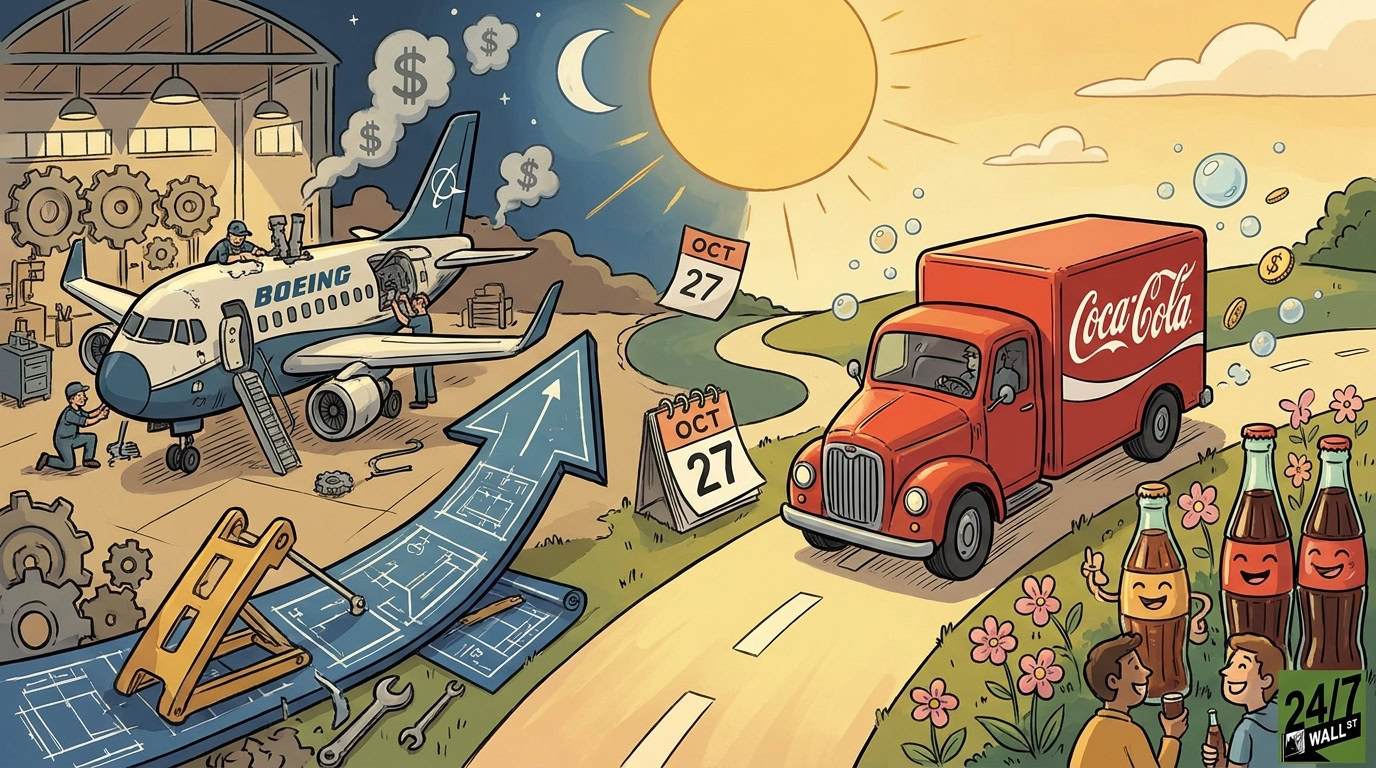
Boeing and Coca-Cola report third-quarter results before the market opens on October 27, but investors are asking almost opposite questions. Boeing must prove that a production recovery can generate dependable cash. Coca-Cola must show that strong brands can keep lifting volume and profit after a 35.7% year-to-date share gain.
Boeing's second quarter offered real progress without completing the turnaround. Revenue rose 8% to $24.6 billion as the company delivered 171 commercial aircraft, according to Boeing. Free cash flow, a non-GAAP measure, improved to $631 million from a $200 million outflow a year earlier. Yet Boeing still posted a $0.76 core loss per share, and a $280 million charge on the VC-25B presidential aircraft program showed how defense execution can absorb gains from higher jet deliveries.
The third-quarter cash result therefore matters more than a single earnings-per-share comparison. Boeing has said it expects free cash flow in the low hundreds of millions of dollars despite a roughly $700 million Justice Department payment. A positive result would suggest that more deliveries and customer advances are beginning to outweigh penalties, development spending and factory investment. A miss would raise doubts about the pace of recovery even if revenue grows.
The 737 MAX 10 adds a second test. The aircraft received certification on October 20 after a long delay, and the source report says airlines have ordered more than 1,400. Investors now need a credible timetable for first deliveries in 2027 and evidence that Boeing can increase 737 production toward 47 aircraft a month without weakening quality or disrupting suppliers. Certification removes one regulatory obstacle, but it does not by itself create cash flow.
Coca-Cola enters the morning from a stronger operating position. In the second quarter, net revenue rose 7% to $13.4 billion, global unit case volume increased 5%, and comparable earnings per share rose 11% to $0.97. The company also raised its full-year comparable EPS growth outlook to 9% to 10%. Coca-Cola Zero Sugar grew volume by 16%, while the World Cup campaign supported demand across several brands.
The harder comparison now begins. Management has warned that the second half faces tougher year-over-year volume comparisons and that the fourth quarter has six fewer selling days. Asia Pacific price and mix fell 9% in the second quarter, so investors should separate broad volume strength from regional pricing pressure. The useful benchmark is Coca-Cola's full-year organic revenue growth target of about 5%, not just whether reported earnings exceed the consensus estimate.
Both companies can beat expectations for very different reasons. Boeing needs production and certification milestones to become cash. Coca-Cola needs resilient volume and pricing to support a premium valuation. The October 27 reports will show whether each company is converting its strongest recent headline into the result that shareholders actually need.
Latest comments