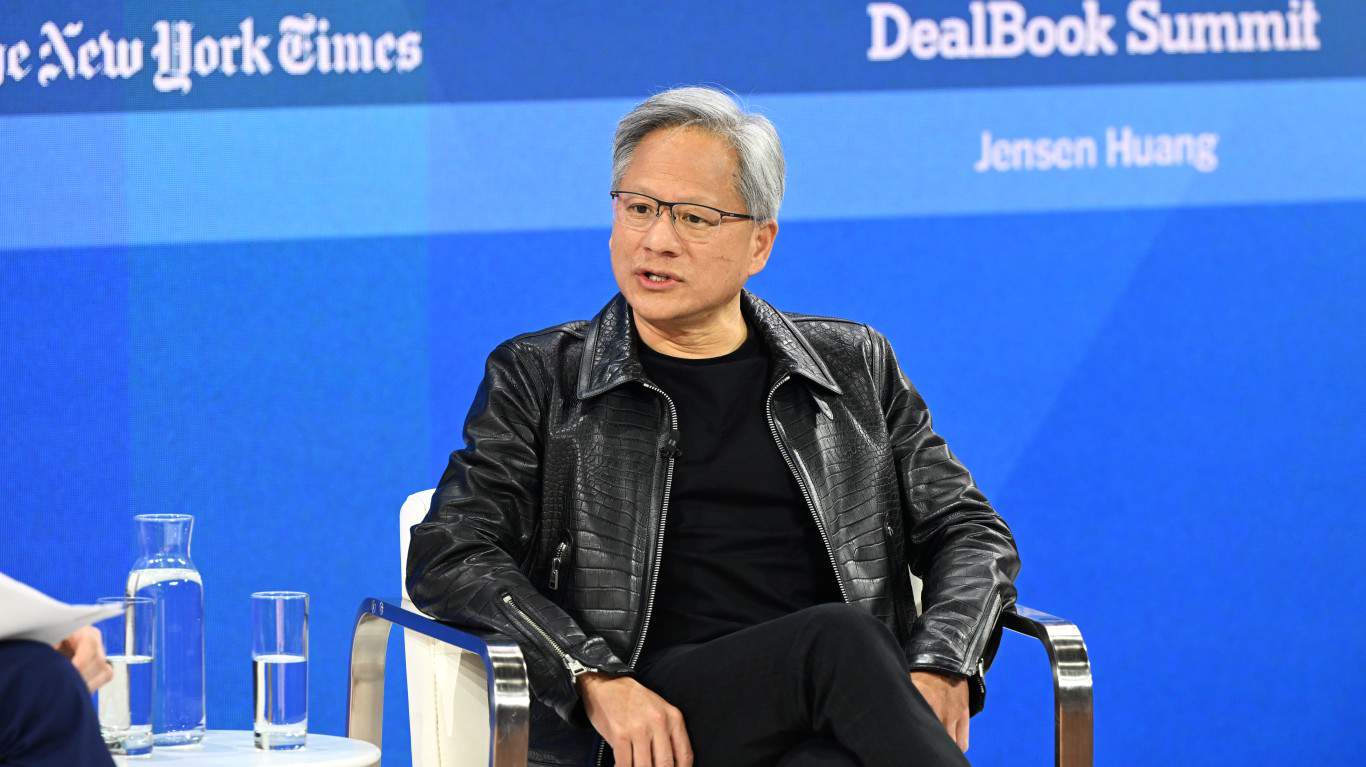
Nvidia is again sitting at the top of the market capitalization rankings, helped in part by a notable commitment from Elon Musk’s Space Exploration Technologies, listed in the source as NASDAQ:SPCX. SpaceX said it will use Nvidia GPUs exclusively, a development framed as a significant victory for Jensen Huang and a major setback for competing chip providers. That exclusive arrangement raises a larger question for investors. The issue is not only whether SpaceX will remain an isolated case, but whether other mega-cap companies could also decide to standardize around Nvidia. The source suggests that if Nvidia continues to offer the strongest technology available, the company may be in position to encourage a deeper form of customer loyalty. With Nvidia described as a $5.3 trillion juggernaut, the argument is that technological leadership may increasingly translate into more exclusive enterprise relationships. The timing of that discussion matters because Nvidia is entering what the source calls the Vera Rubin era. The next-generation Rubin GPU is described as an obvious hot seller, but the broader investment story depends on more than GPU demand alone. To keep growth advancing, Nvidia is looking beyond its already dominant position in graphics processors and moving more aggressively into custom CPUs. That expansion is tied to what Nvidia sees as a $200 billion CPU market, making it one of the company’s next major total addressable market opportunities in the hardware layer of the five-layer cake. The source argues that the CPU opportunity may still be underestimated. As artificial intelligence moves toward what it calls an inference inflection point, GPU performance alone is not enough. A powerful GPU also depends on the CPU paired with it. In that setting, Vera Rubin’s large performance and efficiency gains become more important, because they raise the standard for the surrounding hardware ecosystem as well. Nvidia’s effort to build CPUs designed for agentic AI workloads is therefore positioned as more than an adjacent product move. It is presented as a potentially meaningful new leg of growth. That matters further as the tech sector shifts into what the source calls the agentic AI era. In that environment, agentic-first CPUs could become just as important as GPUs. Because Vera was designed with agentics in mind, the article argues that the chip could become a more meaningful contributor than many analysts currently expect. The broader claim is that Nvidia has only begun to penetrate a CPU market it may be fully capable of competing in at scale. If the company has established clear superiority in GPUs, the source contends it could potentially apply a similar formula in CPUs. Another product named in the source is the RTX Spark desktop chip. Its inclusion reinforces the view that Nvidia’s product roadmap is broadening in ways that make the company increasingly difficult to bet against, particularly as it deepens its presence in CPUs alongside its AI accelerator franchise. The valuation discussion adds another layer to the investment case. Even with Dr. Michael Burry maintaining a short position on Nvidia, the source argues that bearish investors may struggle if the stock continues to attract buyers. Nvidia is described as seemingly undervalued at 33.5 times trailing price-to-earnings, especially given its dominance in semiconductors and the presence of what the article calls new circular deals. Those arrangements are framed as potentially being about loyalty and exclusivity as much as direct investment return. Burry is also cited as having called Nvidia mafia-like while criticizing the company. The article links that remark to Nvidia’s commanding position under Jensen Huang, who it notes some refer to as the Godfather of AI. For investors, the central idea is that Nvidia now combines highly powerful chips, a new growth opportunity in the $200 billion CPU market, and the possibility that exclusivity and loyalty could help it widen the gap over rivals.
stock
Be The Investor Research
Read Original Source (Yahoo Finance)
Nvidia’s Custom CPU Expansion Is the Next $200B Catalyst.
Nvidia’s exclusive GPU commitment from SpaceX, its focus on the $200 billion CPU market through Vera Rubin, and its valuation at 33.5 times trailing earnings are sharpening the investment case around loyalty, expansion, and AI hardware leadership.